
10 Cancer Care Pioneers from Gene Solutions Present Their Latest Research at ESMO Asia 2024
At the ESMO Asia Congress 2024 (Singapore, 6-8 December), Gene Solutions is proud to present groundbreaking research through 9 posters and 1 oral presentation, addressing critical challenges in oncology across Asia.
These presentations cover key advancements in early cancer detection, minimal residual disease (MRD) tracking to predict relapse risks, treatment assessment, comprehensive genomic profiling (CGP) and fusion-derived neoantigens for effective cancer vaccines design. Gene Solutions is dedicated to advancing personalized cancer care and integrating innovative genomic technologies into daily clinical practice.
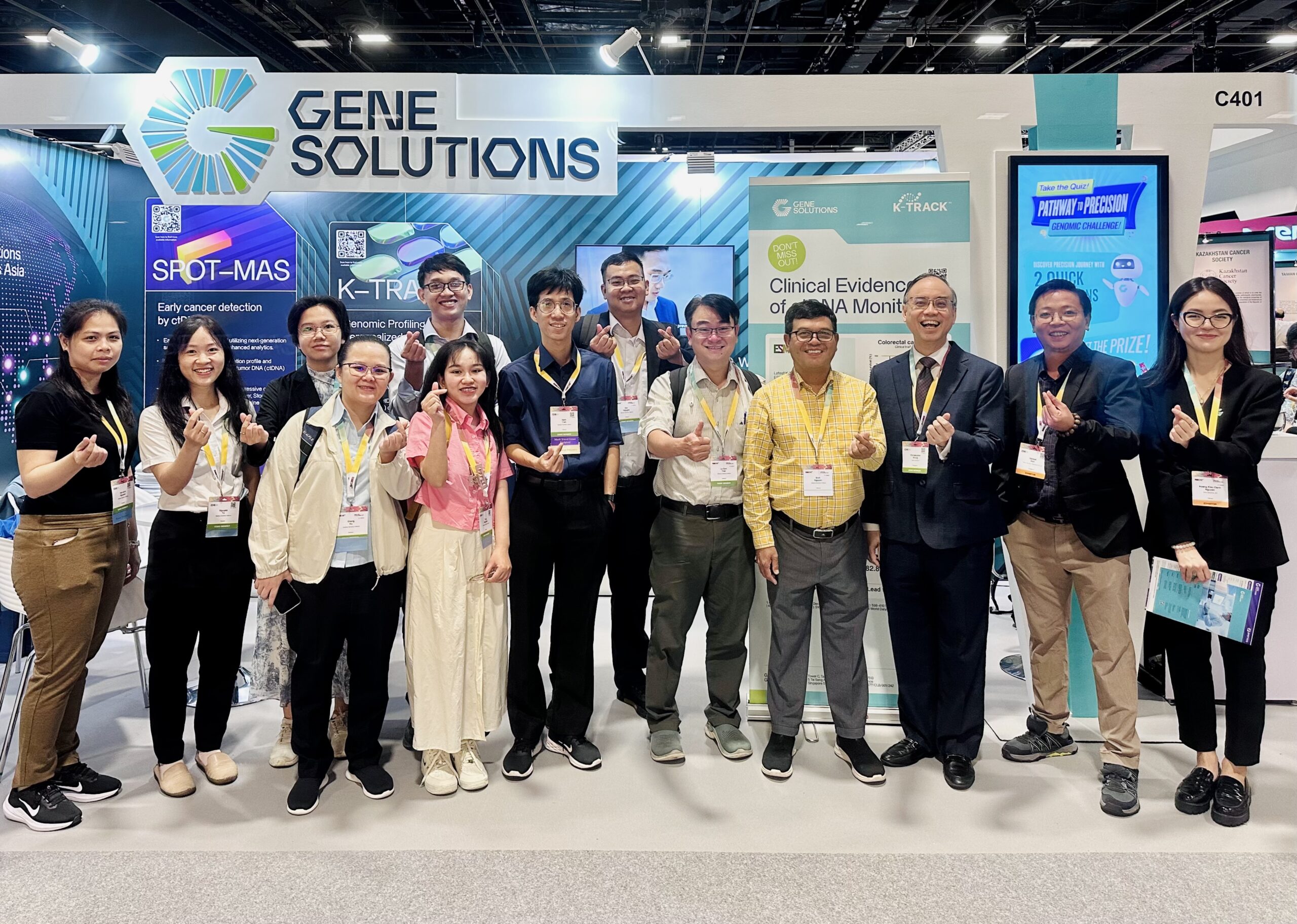
The Gene Solutions team proudly presented 10 key research contributions at ESMO Asia 2024
1 Mini Oral Presentation on Homologous recombination deficiency (HRD) testing for ovarian cancer
HRD prevalence is not well-characterized in developing countries, this present showcased how the innovative HRD Insight test is transforming patient care with its high sensitivity, specificity, and cost-effectiveness
Title: Homologous recombination deficiency testing in Vietnamese patients with ovarian cancer
Speakers: Nam H. Tran
Key Highlight Finding:
- HRD Insight test combining BRCA mutation and genome-wide CNA assessment is a highly reliable and affordable solution to determine HRD status for OC patients.
- High sensitivity and specificity (>99%) for both BRCA1/2 (germline and somatic) variants and Genomic instability status
- >50% of OC patients in Vietnam were HRD-positive and could benefit from PARPi treatment.
Link Access to Abstract: ESMO Asia Congress 2024 | OncologyPRO
4 Posters on Personalized Cancer Care:
In the era of Precision Medicine, Gene Solutions is pioneering the transformation of cancer care through personalized oncology.
| No. | Title | Key Highlight Finding | Link to the Abstract |
| 1 | 509P – Real-world utilization and performance of circulating tumor DNA monitoring to predict cancer recurrence early in Southeast Asia | 1st real-world evaluation of ctDNA monitoring (K-TRACK test) in Southeast Asia.
The addition of the hotspot panel improved the pre-treatment detection rate of ctDNA Patients with ctDNA positivity after treatment had a significantly higher risk of recurrence (p<0.001); ctDNA showcased value in predicting treatment response in patients at the metastatic stage in serial case studies |
Click here |
| 2 | 497 – Tumor-naïve approach for circulating tumor DNA analysis in multiple types of cancer | The tumor-naïve ctDNA assay (Blood Only option of K-TRACK test), which integrating genome-wide features with mutations, can reliably detect ctDNA in multiple types of cancer. This combination increased the detection rates of liver cancer in early-stage (96.2%) and almost cancer in metastatic stage.
The prognostic value of post-operative ctDNA showed sensitivities of 87.5%, 84.6%, and 54.5% in colorectal, lung, and breast cancers, respectively. The average lead time before clinical diagnosis was up to 14.4 months. ctDNA has demonstrated value in predicting ICI and TKI response in patients at the metastatic stage in serial case studies. |
Click here |
| 3 | 517P – Circulating tumor DNA dynamics to predict response to tyrosine kinase inhibitors in patients with advanced non-small cell lung cancer: an interim report | Combination of Genome-Wide (GW) Features with Hotspot Mutations:
• Pre-treatment: Sensitivity of ctDNA detection rate improved from 72.2% to 94.4% at baseline. • During treatment: Enhanced sensitivity demonstrates ctDNA’s potential for monitoring treatment response. ctDNA Dynamics During Treatment: • In patients with partial response, ctDNA levels either decreased but remained detectable or stayed negative. • In patients with disease progression, ctDNA levels increased following treatment. |
Click here |
| 4 | 500P – Tumor comprehensive genomic profiling: clinical implications and utilization in Vietnam | Validation of K-4CARE assay showcased:
• High sens and spec (94 – >99%) for both SNVs, INDELs, Amplification and Fusion somatic variants. • High sens and spec (>99%) for both SNVs and INDELs germline variants. • High concordance with standard method for TMB (94%) and MSI (97%). The clinical implication of comprehensive genomic profiling showed that K-4CARE provided high reliable genomic information, enabling the detection of guideline-based biomarker testing for both targeted therapy and immunotherapy. |
Click here |
4 Posters on Cancer Early Detection:
With Asia representing 49.3% of global cancer cases (1), the need for innovative solutions like next-generation sequencing (NGS) is more critical than ever. Gene Solutions is committed to advancing early detection technologies to address this challenge and improve outcomes across the The Asia-Pacific.
| No. | Title | Key Highlight Finding | Link to the Abstract |
| 1 | Merit Travel Grants 733P – Real-world experience with a multi-cancer early detection test in Southeast Asia |
The real-world experience across Southeast Asian countries (*) aligns with large-scale studies, effectively detecting cancer signals and predicting cancer signals origin, including for cancers lacking standard screening.
In a total of 10,577 cases, there are 34 true positives. The study highlighted 1 cancerous case in lung (stage III) and 1 precancerous one in colorectum. (*) The study was a collaboration with several prominent institutions including the Faculty of Medicine at Ramathibodi Hospital, Mahidol University (Thailand), Phyathai Hospital’s Obstetrics and Gynecology department (Thailand), Hatvai Hospital’s Internal Medicine department (Thailand), and Vichaiyut Hospital’s Oncology department (Thailand), St. Luke’s Medical Center (Philippines), Dr. Jesus Delgado Memorial Hospital (Philippines), Genelab Ph, Wellness Center at The Medical (Philippines), the National Kidney and Transplant Institute (Philippines), Clinica Manila (Philippines), PT Innolab Sains International (Indonesia). |
Click here |
| 2 | Merit Travel Grants 523P – Combination of hotspot mutations with methylation and fragmentomic profiles to enhance multi-cancer early detection |
Combining 700 hotspot mutation analysis with SPOT-MAS assay (SPOT-MAS PLUS) enhances early cancer detection across multiple cancer types, with a specificity of 97.7% and overall sensitivity to 78.4%. | Click here |
| 3 | 524P – A blood ctDNA multimodal-based assay for early detection of aggressive cancer types lacking standard screening tests | Methylation and fragmentomic signatures shared with common cancers (breast, colorectal, liver, lung, gastric) were prominent in cancers lacking standard-of-care (LSS) screening (endometrial, esophageal, head and neck, ovarian, and pancreatic cancers).
The assay achieved a specificity of 96.2% and an overall sensitivity of 74.8% for LSS cancers. SPOT-MAS, a non-invasive test trained on 5 common cancer types, has the potential to detect a number of LSST cancer cases, thereby complementing existing screening programs. |
Click here |
| 4 | 170P – Differentiation between malignant and benign gastric lesions by multimodal plasma cell-free DNA analysis | One of our AI model achieved an AUC of 82.93%, a specificity of 93.8% and sensitivities of 64.0%, and 77.8% for early nonmetastatic stages (I-IIIA), and late metastatic stages (IIIB-IV), respectively.
This demonstrates that the multimodal approach achieves high accuracy in differentiating gastric cancer from gastric inflammation, effectively reducing false-positive results caused by this condition.
|
Click here |
1 Poster on Neoantigen: Personalized cancer immunotherapy
Promising results underscores the transformative potential of GF-derived neoantigens in personalized cancer immunotherapy, paving the way for innovative therapeutic strategies
| No. | Title | Key Highlight Finding | Link to the Abstract |
| 1 | Best Poster Award 486P – Fusion-derived neoantigens: Broadening the horizons of personalized cancer immunotherapy |
Despite a lower prevalence of neoantigens per patient (2%-33%), gene fusion (GF) exhibit more complex genetic alterations across multiple chromosomes.
Most neoantigens are patient-specific, with a low recurrence rate (<8%). GF-derived neoantigen loads, but not SNV/Indel neoantigen loads, strongly correlate with tumor fraction, emphasizing their critical role in tumor immunity. GF-derived neoantigens drive CD8+ T cells toward an exhausted and stronger effector phenotype, while SNVs predominantly induce CD4+ T cell responses. |
Click here |
About Gene Solutions:
Gene Solutions is a pioneering and prominent genetic testing company in Asia, dedicated to developing and providing access to next-generation genetic testing. The company supports:
- Reproductive Health: Offering unique Non-invasive Prenatal Testing (NIPT) that integrates screening for Recessive and Dominant Single-Gene Disorders.
- Clinical Oncology: Including Multi-cancer Early Detection (MCED), Comprehensive Genomic Profiling (CGP) for precision therapy selection, and Minimal Residual Disease (MRD) tracking using circulating tumor DNA (ctDNA) technology.
Gene Solutions envisions empowering healthcare in the region through advanced genomics and multi-dimensional artificial intelligence. With over 1.5 million tests provided to patients, the company demonstrates its commitment to accessible genetic testing services
Reference:
- Huang J, Ngai CH, Deng Y, et al. Cancer Incidence and Mortality in Asian Countries: A Trend Analysis. Cancer Control. 2022;29:10732748221095955. doi:10.1177/10732748221095955


