
Gene Solutions Announces SPOT MAS Multi-omic Dataset on 75 Cancer Subtypes
Singapore, 26 September 2025
SPOT-MAS is Gene Solutions’ AI-powered cfDNA platform for multi-cancer early detection (MCED) and tumor-of-origin (TOO) localization across 10 cancer groups—integrating genetics, epigenetics, and fragmentomics in one streamlined workflow.
Validated across multiple cancer types, the company today unveils the breadth of its multi-omic dataset, encompassing 75 cancer subtypes. This dataset provides deeper molecular and pathological intelligence, with the potential to enhance detection performance, as suggested by recent observations in early breast cancer detection studies.
Overview of SPOT-MAS Multi-cancer early detection (MCED) test
- Clinically validated leadership
SPOT‑MAS is the first MCED test in Asia to complete a large, prospective cohort validation (n=9,024) with results published in BMC Medicine (2025).
Refs: PR Newswire—Mar 26, 2025, BioPharma APAC—Mar 27, 2025 - Deeper molecular and pathological intelligence
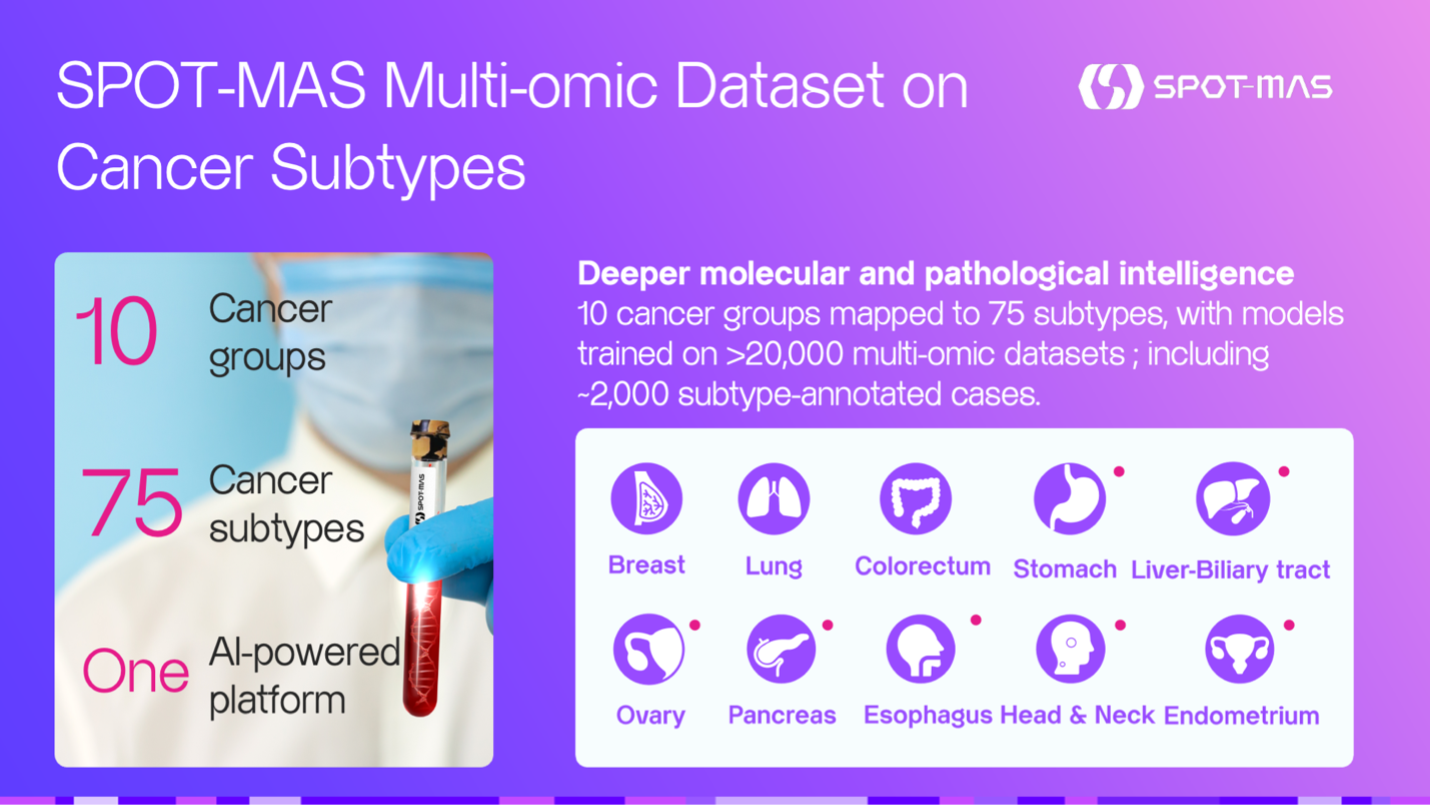
10 cancer groups mapped to 75 subtypes, with models trained on >20,000 multi‑omic datasets; including ~2,000 subtype-annotated cases.
Source: Company data on file (2018–2025) - AI + Multi-omics advantage
One integrated workflow fusing methylomics, fragmentomics, CNAs, end motifs—enabling high specificity at screening-appropriate sequencing depths.
Refs: eLife 2023 - Growing clinical access
Available through select hospitals and clinics across Asia (availability varies).
Refs: Health Outreach Programme (Singapore) , Sunway Medical Centre (Malaysia), BangKok Hospital Chiang Mai (Thailand) , The Medical City (Philippines), KALGen Innolab (Indonesia)
Why Subtype-Level Intelligence Matters
Clinical Spotlight: Breast Cancer
Early stage breast cancer is known to have low ctDNA shedding and marked subtype heterogeneity—factors that depress sensitivity across many assays, particularly in screening settings.
Refs: (K-TRACK MRD study)
Deep understanding of subtypes diversity → measurable performance gains
New peer reviewed data (BMC Biology 2025):
A multimodal cfDNA analysis that explicitly learns from benign lesions and breast cancer subtypes demonstrated clinically meaningful improvement over earlier MCED case–control performance for breast cancer.
- Study design: Discovery cohort n=515 (273 BC; 108 benign; 134 healthy) and an independent validation cohort n=119 (BI‑RADS 3–5).
Ref: BMC Biology 2025 - Performance:
- Test set: Sensitivity 66.2% at high specificity (pairwise specificities ~91–96%).
- Validation cohort (BI‑RADS 3–5): Sensitivity 65.1%, specificity 96.1%—notably strong at differentiating benign from malignant, which can reduce unnecessary biopsies.
- Early stage (I–II) sensitivity: 62.1–66.3%.
- Subtype sensitivities (test set): Luminal B 69.6%, TNBC 63.6%, Luminal A 63.6%, HER2‑enriched 61.9%, Luminal B‑HER2 60.0%.
Ref: BMC Biology 2025
- Compared with earlier MCED case–control breast performance:
66.2% vs. 49.3%, indicating a substantial lift when the model is trained on breast specific and benign included signatures.
Refs: BMC Biology 2025—Discussion cites 66.2% vs 49.3%, eLife 2023 MCED
What changed?
Incorporating subtype-specific methylation & fragmentomic signals + benign lesion data makes the model better at detecting low-shedding, heterogeneous subtypes— where early breast detection is hardest.
Why this matters:
This subtype diversity helps SPOT‑MAS learn signature nuances across biology, supporting the observed improvements in sensitivity and specificity for breast cancer and enabling better TOO localization when a signal is present.
Refs: BMC Biology 2025, npj Breast Cancer 2025 , eLife 2023
From Broad Detection to Deep Understanding
10 cancer groups. 75 subtypes. One AI-powered platform.
By mapping Gene Solutions’ multi-omics platform at the subtype level, the SPOT-MAS analytical model gains deeper molecular and pathological intelligence, with the potential to enhance performance across different cancer types and diverse populations.
List of cancer groups and number of subtypes (as of 31st August 2025)
- Breast Cancer: 10 subtypes
(4 Molecular + 6 Pathology) - Colorectal Cancer: 12 subtypes
(4 Molecular-CMS + 8 Pathology/Precancerous) - Lung: 13 subtypes
(Pathology, including NSCLC, SCLC, neuroendocrine, sarcoma, salivary-gland type) - Stomach (Gastric cancer): 6 subtypes
(Pathology) - Liver & Biliary Tract: 8 subtypes
(6 Liver HCC subtypes+ 2 Cholangiocarcinoma) - Head & Neck: 12 subtypes
(10 Anatomical + 2 Pathology) - Ovary: 7 subtypes
(Pathology: epithelial, sex cord–stromal, germ cell) - Esophagus: 5 subtypes
(Pathology) - Endometrium: 1 subtype
(Pathology) - Pancreas: 1 subtype
(Pathology)
DID YOU KNOW?
How SPOT‑MAS works – now with a faster turnaround time!
- One blood draw → plasma cfDNA isolation
- Next-Generation Sequencing (targeted + shallow Whole Genome Sequencing) captures multi-omics features: genetics, epigenetics and fragmentomics
- AI models deliver MCED result and TOO localization
- New turnaround time: 12 working days (previously 20)
- Clinician‑guided follow‑up (positives proceed to diagnostic imaging per local protocols)
Who it’s for?
- Adults ≥40 or those with elevated cancer risk (genetic predisposition, lifestyle exposures, chronic viral hepatitis), seeking comprehensive screening beyond organ‑specific imaging programs.
- Health systems & employers building population early detection programs targeting high‑burden cancers lacking standard screening.
Compliance & important information
- SPOT‑MAS is a screening test; it does not diagnose cancer. Positive results require confirmatory diagnostics per clinical guidelines.
- SPOT‑MAS does not replace established, guideline‑recommended screenings (e.g., mammography, colonoscopy/FOBT, LDCT).
Ready to bring multi‑cancer screening to your program?
▶ Talk to Gene Solutions about market availability, pilot design, and integration with existing screening pathways.
▶ Visit spotmas.com or your local Gene Solutions site to connect with our clinical team.


