
Gene Solutions Showcases MRD and Multi-Omics Advances at Singapore Society of Oncology Annual Scientific Meeting 2025
Gene Solutions hosted a landmark symposium titled “Advancing Precision Oncology: Molecular Residual Disease (MRD) and Multi-Omics in Solid Tumors” at the Singapore Society of Oncology (SSO) Annual Scientific Meeting, held in Singapore on October 14, 2025. The event convened leading oncologists and researchers to explore how circulating tumor DNA (ctDNA)- based -MRD and multi-omics are transforming cancer care, with a focus on improving outcomes for patients in Singapore and across the Asia-Pacific (APAC) region.
Opening Remarks: A Vision for Precision Oncology
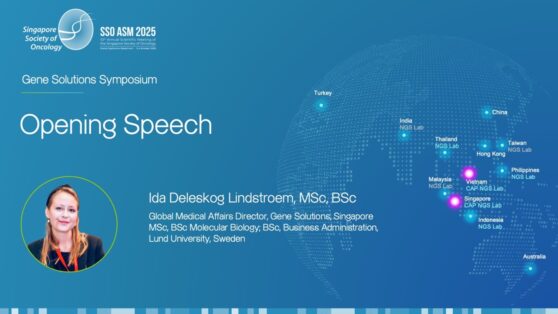
Ida Deleskog Lindstroem, Global Medical Affairs Director, Gene Solutions, opened by emphasizing the importance of collaboration to accelerate precision oncology. She reflected on the company’s growing role in the region, where Gene Solutions’ CAP-accredited Singapore laboratory and global operation network including Turkey, Hong Kong, India, Malaysia, Thailand, Indonesia, Singapore, Vietnam, Taiwan, Philippines, China and other markets., This network has served over 80,000 cancer patients, with 12,000+ benefiting from ctDNA-MRD monitoring.
“These numbers represent lives transformed,” Ida noted, underscoring the mission to translate cutting-edge science into accessible care. She cited growing global adoption, including recommendations by the Japan Society of Clinical Oncology (JSCO) 2025 and U.S. Medicare reimbursement, while noting that the European Society for Medical Oncology (ESMO) and American Society of Clinical Oncology (ASCO) /ASCO guidance is still evolving. She reaffirmed Gene Solutions’ commitment to ensuring MRD and multi-omics advancements deliver meaningful improvements for patients across diverse healthcare systems.
Insights from Distinguished Speakers
Dr. Lee Chern Siang, Raffles Cancer Centre, Singapore
Quoting Lord Kelvin (“to measure is to know”), Dr Lee emphasized ctDNA-MRD’s analytical and clinical validation, with optimal limits of detection (LOD) of 0.01%. He provided a comprehensive overview of molecular residual disease (MRD) in solid tumors, drawing on global and Asian datasets. Using a Stage III triple-negative breast cancer (TNBC) case, he illustrated ctDNA-MRD’s role as an important biomarker in pre- and post-surgical monitoring.. He discussed the Japanese Society of Clinical Oncology (JSCO) 2025 position paper recommending MRD for risk stratification, further citing CIRCULATE-Japan, where ctDNA positivity predicted inferior 36-month overall survival (71.8% vs. 96%) in patients with colorectal cancer (CRC). Dr Lee concluded by emphasizing the potential of multi-omics approaches, which offers to further expand the role of ctDNA monitoring in precision oncology.
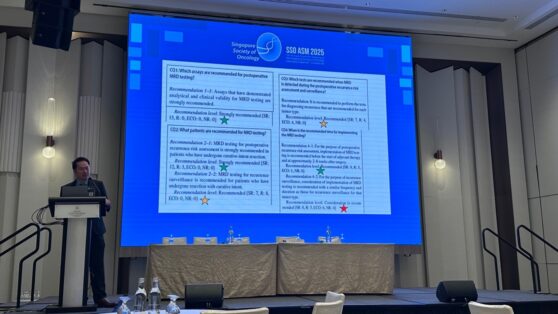
Dr. Lee Chern Siang, Raffles Cancer Centre discussing ctDNA-MRD’s potential in solid tumor monitoring.
Assistant Professor Dr. Tan Chia-Ken Aaron, National Cancer Centre Singapore
Building on this foundation, Dr. Tan explored why multi-omics technologies are essential to capture the complexity of cancer biology. He presented findings from a Gene Solutions study (published in JCO Oncology Advances) showing that combining AI-powered DNA and RNA sequencing improves fusion detection and can predict tissue-of-origin for cancers of unknown primary, underscoring the value of layered molecular insights. Focusing on non-small cell lung cancer (NSCLC), he discussed challenges in early-stage detection and demonstrated how combining genomic and fragmentomic analyses in ctDNA assays can enhance sensitivity. Two lung cancer case studies illustrated how multi-omics-guided ctDNA monitoring can help to inform better personalized treatment decisions.
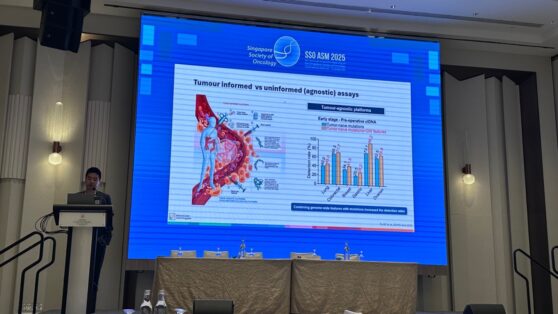
Assistant Professor Dr. Tan Chia-Ken Aaron, National Cancer Centre Singapore, presenting on multi-omics applications.
Panel Discussion: Looking Ahead
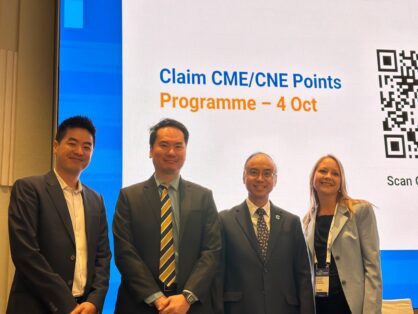
The symposium concluded with a panel discussion moderated by Ida Deleskog Lindstroem, Global Medical Affairs Director, Gene Solutions featuring Dr. Lee Chern Siang, Raffles Cancer Centre, Assistant Professor Dr. Tan Chia-Ken Aaron, NCCS, and Dr. Christopher Wong, Gene Solutions.
The panelists emphasized the clinical advantage of ctDNA-MRD in providing lead time between molecular recurrence and radiological confirmation, giving oncologists a critical window to discuss treatment strategies with patients. In response to audience questions, the panel agreed that ctDNA-MRD could become one of the most important biomarkers for cancer monitoring in the years ahead.
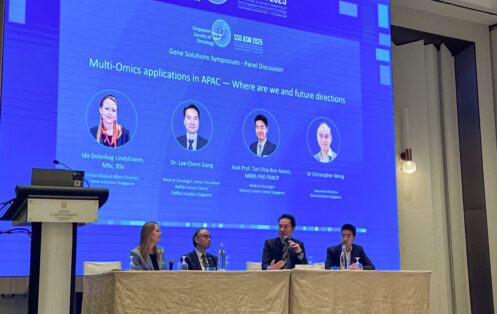
Panel discussion with Ida Deleskog Lindstroem, Global Medical Affairs Director, Gene Solutions (moderator), Dr. Lee Chern Siang, Raffles Cancer Centre, Assistant Professor Dr. Tan Chia-Ken Aaron, National Cancer Centre Singapore, and Dr. Christopher Wong, Gene Solutions, discussing multi-omics and ctDNA-MRD advancements.
Gene Solutions’ Commitment to APAC Cancer Care
The symposium reaffirmed Gene Solutions’ dedication to advancing precision oncology in Singapore and APAC. By combining world-class science, CAP-accredited laboratories, and a regional NGS network, Gene Solutions continues to empower oncologists with data-driven tools for earlier detection, better patient monitoring, and more personalized treatment decisions.
Disclaimer: This newsletter is for informational purposes only and does not constitute medical advice. All claims are based on published data and guidelines. While ctDNA-MRD shows promise, ongoing research is needed to establish its role in diverse populations.


