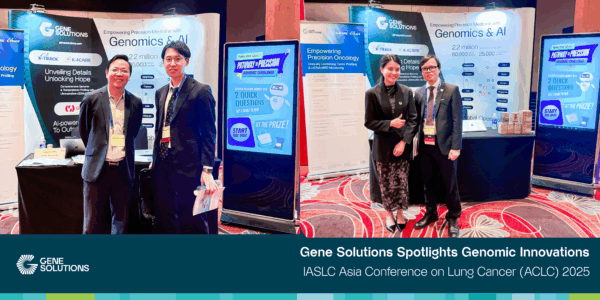
Gene Solutions Spotlights Genomic Innovations at IASLC Asia Conference on Lung Cancer (ACLC) 2025
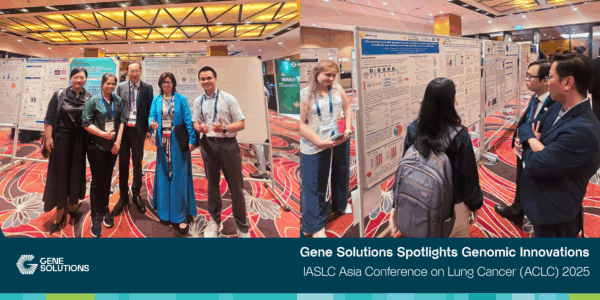
Ho Chi Minh City, October 2025 – Gene Solutions proudly participated as a sponsor at the IASLC Asia Conference on Lung Cancer (ACLC) 2025, held in Ho Chi Minh City from October 9–11. This premier event gathered global and regional experts to share breakthroughs in lung cancer screening, diagnosis, and treatment.
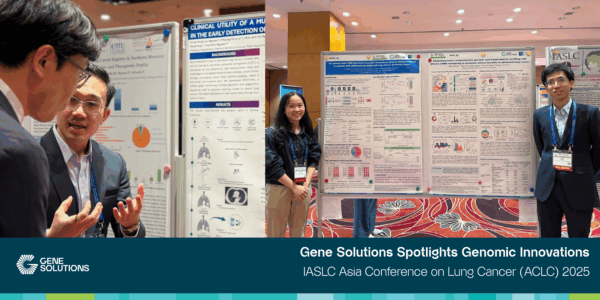
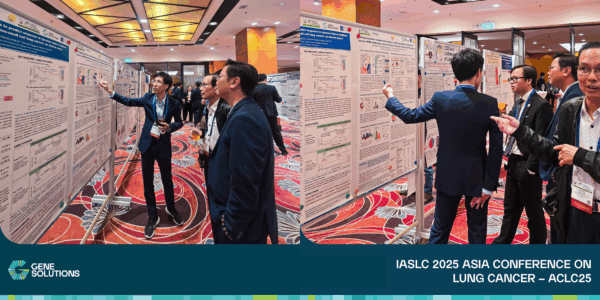
Poster Highlights
Gene Solutions presented five research posters demonstrating how genomics, liquid biopsy and AI are transforming lung cancer care:
- PP01.65 – Prospective Validation of a Cost-Effective Multimodal cfDNA Assay for Early Lung Cancer Detection
SPOT-MAS Lung is a novel, cost-effective blood test that integrates multiple cfDNA features using shallow genome-wide sequencing. In prospective validations across high-risk and symptomatic cohorts, the assay demonstrated strong ability to distinguish malignant from benign nodules, complementing LDCT by reducing false positives and unnecessary invasive procedures. These interim findings underscore its potential as a non-invasive confirmatory tool to improve early lung cancer detection. - PP01.68 – Clinical Utility of a Multi-Omics cfDNA-Based Assay in Early Detection: A Case Series
This poster presented real-world evidence through four cases (three true positives and one true negative) demonstrating the clinical value of SPOT-MAS multi-omics technology. The assay detected early-stage lung cancer in patients with abnormal imaging findings, differentiated non-malignant conditions such as tuberculosis from cancer, and guided risk stratification—supporting its integration into routine clinical workflows to complement imaging and improve decision-making. - PP01.59 – ctDNA Dynamics to Predict Response to Tyrosine Kinase Inhibitors in Advanced NSCLC: Interim Report
This study evaluated how circulating tumor DNA (ctDNA) monitoring can predict treatment response in patients receiving tyrosine kinase inhibitors (TKIs). Among the first 36 patients analyzed, those classified as molecular responders—patients whose ctDNA levels dropped significantly—had a much longer progression-free survival and better clinical outcomes (94% achieved partial response or stable disease). In contrast, molecular non-responders, whose ctDNA did not decline, were far more likely to experience disease progression (75%). Importantly, ctDNA testing detected resistance mutations months before clinical signs appeared, enabling earlier intervention. These findings highlight ctDNA monitoring as a powerful tool to complement imaging and guide timely treatment decisions. - PP01.60 – Integrating Tumor Comprehensive Genomic and Transcriptomic Profiling with Plasma ctDNA MonitoringThis study shows how combining DNA and RNA-based tumor profiling with plasma ctDNA monitoring (K-4CARE assay) can maximize clinical benefits in advanced lung cancer. RNA analysis improved gene fusion detection by 25% compared to DNA-only methods and enabled accurate tissue-of-origin prediction. ctDNA monitoring provided real-time insights into treatment response and early detection of resistance mutations, offering a more complete view of tumor biology to guide precision oncology.
- PP01.56 – Direct Comparison of Tumor-Informed and Tumor-Agnostic ctDNA Assays in NSCLC
This study compared two ctDNA testing approaches for early-stage non-small cell lung cancer (NSCLC):
- Tumor-informed assays, which require high-quality tissue samples to design personalized panels. (K-TRACK assay)
- Tumor-agnostic assays, which do not rely on tissue samples, make them practical when tissue is unavailable—a common challenge in resource-limited settings. (K-TRACK Blood Only assay)
Results showed that post-surgery ctDNA status from both methods predicted recurrence well ahead of clinical diagnosis, with tumor-informed assays reaching 86.7% sensitivity and tumor-agnostic assays 80.0% sensitivity for detecting recurrence. These findings confirm that while tumor-informed testing offers superior accuracy, tumor-agnostic assays remain a reliable alternative when tissue samples are not accessible, ensuring broader applicability in diverse clinical settings.
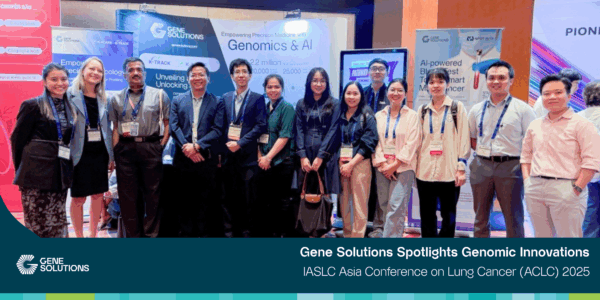
Conference Highlights
ACLC 2025 emphasized precision medicine and multidisciplinary collaboration to improve lung cancer outcomes. Key themes included:
- Early Detection & AI Integration: Expanding LDCT screening and AI-driven risk stratification.
- Biomarker Testing Access: Scaling comprehensive genomic profiling and liquid biopsy.
- Innovative Therapies: Updates on targeted drugs and immunotherapies for EGFR, ALK, KRAS mutations.
- Equity in Care: Addressing disparities in screening and treatment across Asia.
- Public Health Initiatives: Tobacco control and patient advocacy as critical strategies.
Why It Matters
Lung cancer remains the leading cause of cancer mortality worldwide, with Asia bearing a significant burden. By combining genetic insights with clinical expertise, Gene Solutions aims to accelerate adoption of precision oncology and make advanced diagnostics more accessible.
Looking Ahead
Our participation at ACLC 2025 reinforces Gene Solutions’ mission to advance precision oncology through research, technology, and collaboration. We remain committed to working with clinicians, researchers, and healthcare partners to improve patient outcomes and shape the future of cancer care in Asia-Pacific.