
Gene Solutions to Showcase Latest Data on Multi-omics and AI for Precision Oncology at ESMO Asia Congress 2025
Gene Solutions will present latest advancements in multi-omics integration and AI-powered analytics for precision oncology at the European Society for Medical Oncology (ESMO) Asia Congress 2025, taking place December 5–7 in Singapore.
In addition to hosting an Industry Satellite Symposium on December 5 titled “AI-powered liquid biopsy and multi-omics in action: Bridging the gap in genomic insights across the Asia-Pacific region”, Gene Solutions will also present six cutting-edge studies that underscore its commitment to transforming cancer care through innovation and real-world evidence.
These accepted abstracts highlight progress across the cancer care continuum, including early detection, tumor profiling for therapy selection, and recurrence prediction and treatment response monitoring. Drawing on prospective trials and large-scale real-world datasets, Gene Solutions demonstrates how its technologies bring world-class genomics closer to patients in the region.
Key Highlights:
- Early Cancer Detection: Integration of cfRNA and ctDNA for improved colorectal cancer screening, and a validated multimodal cfDNA assay for early lung cancer detection in patients with suspicious nodules.
- Hereditary Risk: The largest study to date on BRCA1/2 pathogenic variants in Vietnamese women, reinforcing the importance of routine genetic testing and counseling in cancer screening and risk-reduction strategies.
- Therapy Optimization: Multi-layer genomic and immune profiling to predict chemotherapy benefit in colorectal cancer, and a novel multi-omics approach combining tumor DNA/RNA sequencing with ctDNA monitoring in advanced lung cancer.
- Cancer Monitoring: A hybrid tumor-informed and tumor-agnostic ctDNA assay delivering high sensitivity and specificity for recurrence prediction and therapy response monitoring, even in resource-limited settings.
Poster Presentations at ESMO Asia 2025
| No. | Title & Speaker | Description |
| Cancer Early Detection | ||
|---|---|---|
| 229P | Integrated cfRNA and ctDNA Liquid Biopsy for Improved Early Colorectal Cancer Screening
Trang T. Tran |
This study evaluates whether integrating plasma cell-free RNA (cfRNA) with cell-free DNA (cfDNA) from a single blood draw can improve non-invasive early colorectal cancer (CRC) detection. Using data from the K-Discovery cohort, cfRNA signatures derived from tumor–normal differential expression were combined with established cfDNA features—including methylation, fragmentomics, end-motif patterns, and copy-number alterations—to train a multi-omics machine-learning model. While the cfRNA-only classifier demonstrated solid performance, its integration with the cfDNA model significantly enhanced accuracy, achieving higher sensitivity and specificity, particularly for stage I–II cancers and precancerous adenomas. A total of 131 dysregulated cfRNAs highlighted both tumor-intrinsic biology and immune-related pathways, underscoring their complementary value. These findings demonstrate that cfRNA–cfDNA integration meaningfully strengthens early CRC detection and supports further validation in larger prospective cohorts. |
| 913P | Development and Clinical Validation of a Multimodal Cell-Free DNA Assay for Early Detection of Lung Cancer in Patients with Suspicious Pulmonary Nodules
Ho D. Vo |
This study reports the development and clinical validation of SPOT-MAS Lung, a multimodal cell-free DNA assay designed to support early lung cancer detection in patients with LDCT-identified suspicious nodules. Using shallow whole-genome sequencing to extract fragmentomic patterns, nucleosome footprints, end motifs, and copy-number alterations, a two-stage machine-learning model was trained in the K-Discovery cohort and subsequently validated prospectively in the LUNG CARE study. The assay consistently distinguished cancer from both healthy individuals and benign nodules, achieving high sensitivity and specificity in retrospective analysis and robust performance in real-world validation, including strong positive predictive value in Lung-RADS 4 cases. These findings highlight SPOT-MAS Lung as a minimally invasive, cost-effective tool that can refine risk stratification, reduce false positives, and accelerate diagnostic decision-making for patients with indeterminate pulmonary nodules. |
| 11P | Prevalence and Spectrum of BRCA1 and BRCA2 Pathogenic Variants in a Large Cohort of 14,529 Vietnamese Women
Le Phuong-Thuy |
This large-scale cross-sectional study of 14,529 Vietnamese women provides the most comprehensive assessment to date of pathogenic variant in the BRCA1 and BRCA2 prevalence in Vietnam. Using a validated NGS pipeline and ACMG classification, the study identified a 2.4% carrier frequency, with BRCA1 variants occurring more than twice as often as BRCA2. Nearly half of all carriers had a personal history of breast and/or ovarian cancer, and the majority of these women were diagnosed at or before age 50, underscoring the substantial clinical impact of hereditary risk. A recurrent nonsense variant (p.Arg1751Ter) in BRCA1 gene accounted for 15.7% of all pathogenic variant findings, confirming its status as a major mutation in the Vietnamese women population. These results provide robust real-world evidence supporting the integration of routine BRCA1/2 testing and genetic counseling into standard cancer screening and risk-reduction guidelines. |
| Tumor Profiling for Therapy Selection | ||
| 227P | Integrated Genomic and Immune Profiling Improves Chemotherapy Benefit Prediction in Resectable Colorectal Cancer
Tran B. Nguyen |
This study demonstrates that integrating multi-layer genomic and immune profiling significantly improves prediction of adjuvant chemotherapy benefit in resectable colorectal cancer. Using DNA, RNA, and TCR sequencing from paired tumor–blood samples, the authors evaluated 131 features spanning neoantigens, neoantigen-reactive T-cell repertoire, and tumor microenvironment composition. While mutation and neoantigen burden alone showed limited predictive value, TCR repertoire metrics—particularly total clone count and convergent neoantigen-reactive clones—emerged as strong predictors of favorable FOLFOX response, further enhanced by CD4⁺ T-cell–enriched microenvironments. The resulting Fusion-TCR Immune Composite Score (FTICS) correlated with progression-free survival and outperformed traditional single-marker approaches, highlighting a biologically grounded framework for more accurate risk stratification in future adjuvant CRC management. |
| 791P | Harnessing multi-omics data from tumor and plasma ctDNA profiling in advanced lung cancer
Phuc Nguyen |
This study evaluates a novel multi-omics strategy that integrates tumor DNA and mRNA sequencing with longitudinal plasma ctDNA monitoring. By leveraging a high-density probe (HDP) panel for DNA analysis and RNA sequencing for fusion detection and tissue-of-origin prediction, alongside ctDNA profiling for real-time treatment response, the approach aims to enhance biomarker detection and clinical decision-making. Findings demonstrate improved sensitivity for actionable mutations, fusion variants, and resistance mutations, underscoring the potential of multi-omics integration to optimize personalized treatment in lung cancer. |
| Recurrence prediction and therapy response monitoring | ||
| 784P | Real world performance of the hybrid tumor-informed and tumor-agnostic ctDNA testing to predict cancer recurrence and progression in Southeast Asia
Van-Anh H. Nguyen |
Circulating tumor DNA (ctDNA) has emerged as a powerful biomarker for monitoring treatment response and predicting cancer recurrence. Conventional tumor-informed ctDNA testing depends on high-quality tissue samples, which are often difficult to obtain in resource-limited settings. To address this challenge, we developed and evaluated a hybrid approach combining tumor-informed and tumor-agnostic strategies. This method integrates personalized mutation tracking with a hotspot panel to enhance detection in both optimal and suboptimal samples. Real-world data from Southeast Asia demonstrate that this hybrid assay improves ctDNA detection rates, enables early prediction of recurrence, and provides clinically relevant insights into treatment response and resistance mutations across multiple cancer types. |
Join Us at ESMO Asia 2025
1. Industry Satellite Symposium: Gene Solutions – AI-powered liquid biopsy and multi-omics in action: Bridging the gap in genomic insights across the Asia-Pacific region
December 5, 16:00–17:00 SGT | Hall 405, ESMO Asia Congress, Suntec Singapore Convention & Exhibition Centre
Discover how AI-powered liquid biopsy and multi-omics are bridging genomic gaps across Asia-Pacific.
Chairs: Prof. Nick Pavlakis (The University of Sydney, Australia) and Prof. Herbert Ho Fung Loong (The Chinese University of Hong Kong, Hong Kong SAR)
2. Poster Presentations:
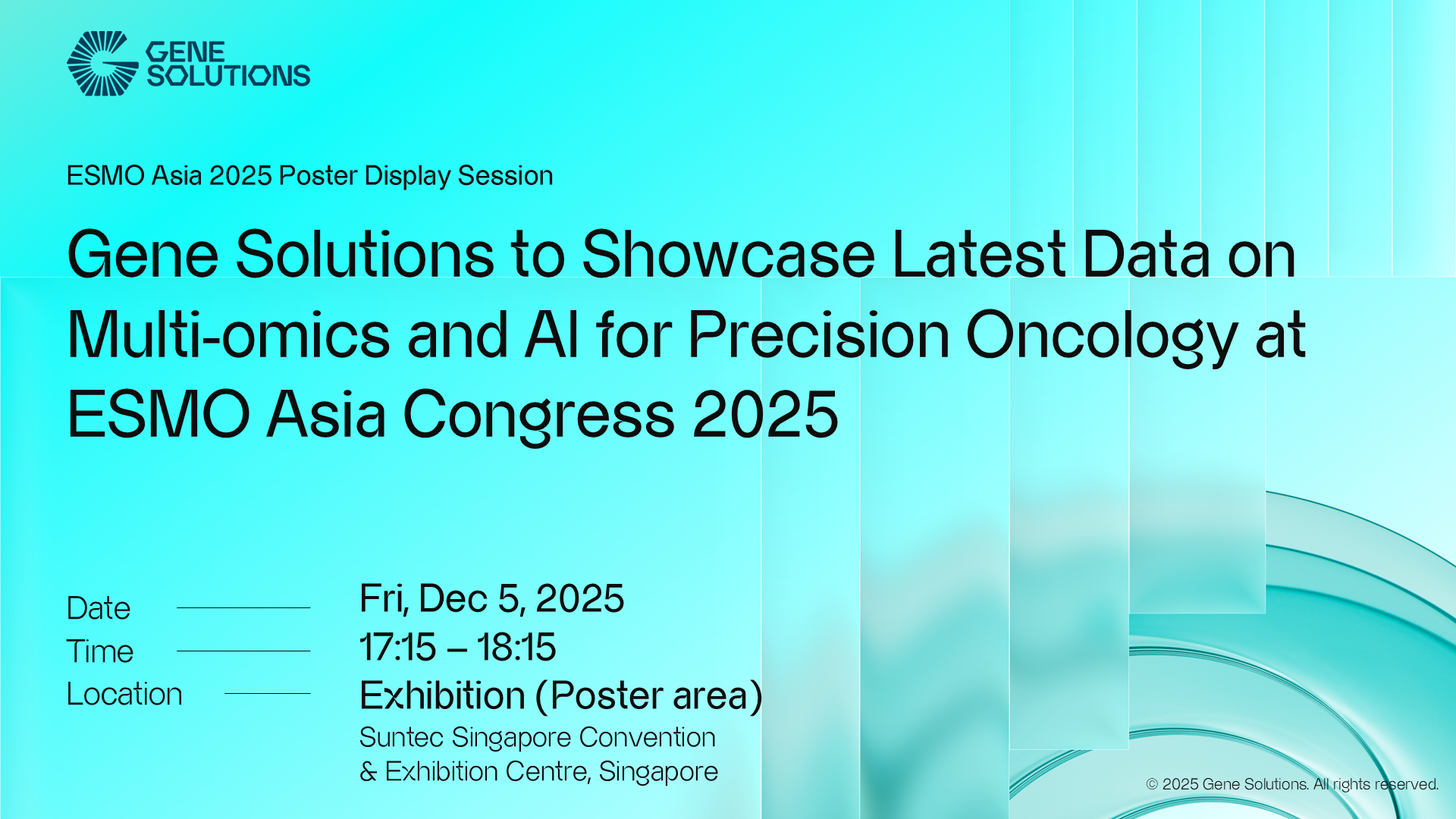
December 5, 17:15–18:15 SGT | Poster Area, ESMO Asia Congress
Explore the latest data in multi-omics and AI across cancer care from six innovative studies.
3. Exhibition Booth:
Visit our booth to meet the Gene Solutions team, learn about our technologies through interactive challenges, and discuss collaboration opportunities.


