
Single-Gene Disorders. Lifelong Impact. Early Screening Matters.
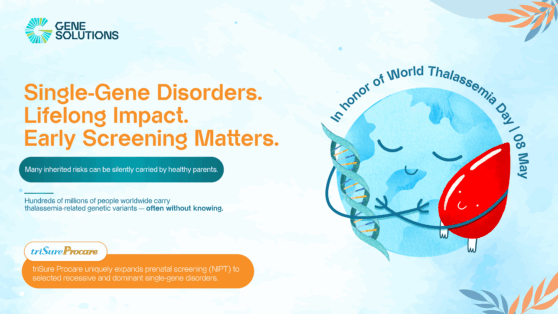
8 May marks World Thalassemia Day — a global moment to honor families living with thalassemia and raise awareness of inherited blood disorders. In 2026, the global campaign theme, “Hidden No More: Finding the Undiagnosed. Supporting the Unseen,” reminds us that early awareness and access to screening can help bring silent genetic risks into view (1).
Thalassemia is one of the most common inherited blood disorders worldwide. Many carriers are healthy and may not know they carry a genetic variant. Globally, around 5% of the population are estimated to carry an α-thalassemia variant (2), while β-thalassemia carriers represent approximately 1.5% of the global population, or about 80–90 million people worldwide (3).
This burden is especially relevant across the thalassemia belt, including the Mediterranean, Middle East, South Asia, and Southeast Asia. In Southeast Asia, α-thalassemia is particularly common, with a meta-analysis reporting an overall α-thalassemia prevalence of 22.6% across selected Southeast Asian populations, including high reported prevalence in Vietnam, Cambodia, Laos, Thailand, and Malaysia (4).
For many families, the challenge is that carrier status often has no obvious symptoms. A parent can feel completely healthy while carrying a recessive genetic condition. If both parents carry disease-causing variants in the same recessive disease gene, their baby may be at risk of being affected. Carrier screening helps individuals and couples understand inherited reproductive risks earlier and supports more informed conversations with healthcare professionals about pregnancy and family planning (5).
While screening before pregnancy is ideal, many couples only begin thinking about genetic risk after pregnancy has already started. The American College of Medical Genetics and Genomics recommends that carrier screening be offered to pregnant women and those planning pregnancy, including broader screening for autosomal recessive and X-linked conditions (5).
This World Thalassemia Day, Gene Solutions highlights the importance of screening not only for thalassemia, but also for broader monogenic disorders — conditions caused by changes in a single gene. Some monogenic disorders are recessive, meaning parents may be healthy carriers. Others are dominant, meaning a single genetic change may be enough to cause disease, including cases that may occur without a known family history.
With triSure Procare, Gene Solutions supports a broader prenatal screening journey for families. triSure Procare integrates screening for 18 recessive diseases in maternal blood, including Alpha Thalassemia and Beta Thalassemia carrier assessment, together with screening for 25 common dominant single-gene disorders.
Building on Gene Solutions’ experience in providing integrated NIPT solutions to millions of pregnant women across Southeast Asia, triSure Procare reflects the company’s continued commitment to making broader prenatal genetic screening more accessible in the region. By expanding beyond common chromosomal conditions, triSure Procare helps bring greater attention to single-gene disorders that may otherwise go unnoticed until later in life or after birth.
At Gene Solutions, we celebrate World Thalassemia Day by standing with families, supporting awareness, education and advancing access to prenatal genetic screening.
Because when a single gene can shape a lifetime, early knowledge matters.
Important notice: As with all screening technologies, results should be interpreted with appropriate clinical counseling. A screening result is not a diagnosis; positive or high-risk findings should be followed by confirmatory diagnostic testing when clinically indicated.
References
(1) Thalassaemia International Federation. International Thalassaemia Day 2026: Hidden No More – Finding the Undiagnosed. Supporting the Unseen. Thalassaemia International Federation; 2026.
(2) Piel FB, Weatherall DJ. The α-Thalassemias. New England Journal of Medicine. 2014;371(20):1908–1916. doi:10.1056/NEJMra1404415.
(3) Colah R, Gorakshakar A, Nadkarni A. Global burden, distribution and prevention of β-thalassemias and hemoglobin E disorders. Expert Review of Hematology. 2010;3(1):103–117. doi:10.1586/ehm.09.74. PMID: 21082937.
(4) Goh LPW, Chong ETJ, Lee PC. Prevalence of Alpha (α)-Thalassemia in Southeast Asia (2010–2020): A Meta-Analysis Involving 83,674 Subjects. International Journal of Environmental Research and Public Health. 2020;17(20):7354. doi:10.3390/ijerph17207354. PMID: 33050119.
(5) Gregg AR, Aarabi M, Klugman S, et al.; ACMG Professional Practice and Guidelines Committee. Screening for autosomal recessive and X-linked conditions during pregnancy and preconception: a practice resource of the American College of Medical Genetics and Genomics. Genetics in Medicine. 2021;23:1793–1806. doi:10.1038/s41436-021-01203-z.


