
Gene Solutions Thailand Exhibition & Symposium Highlight at TSCO Annual Meeting
Explore the highlights from our booth exhibition and symposium at the Thai Society of Clinical Oncology (TSCO) Annual Meeting, held from October 18-20, 2024, at Dusit Thani Pattaya, Thailand.
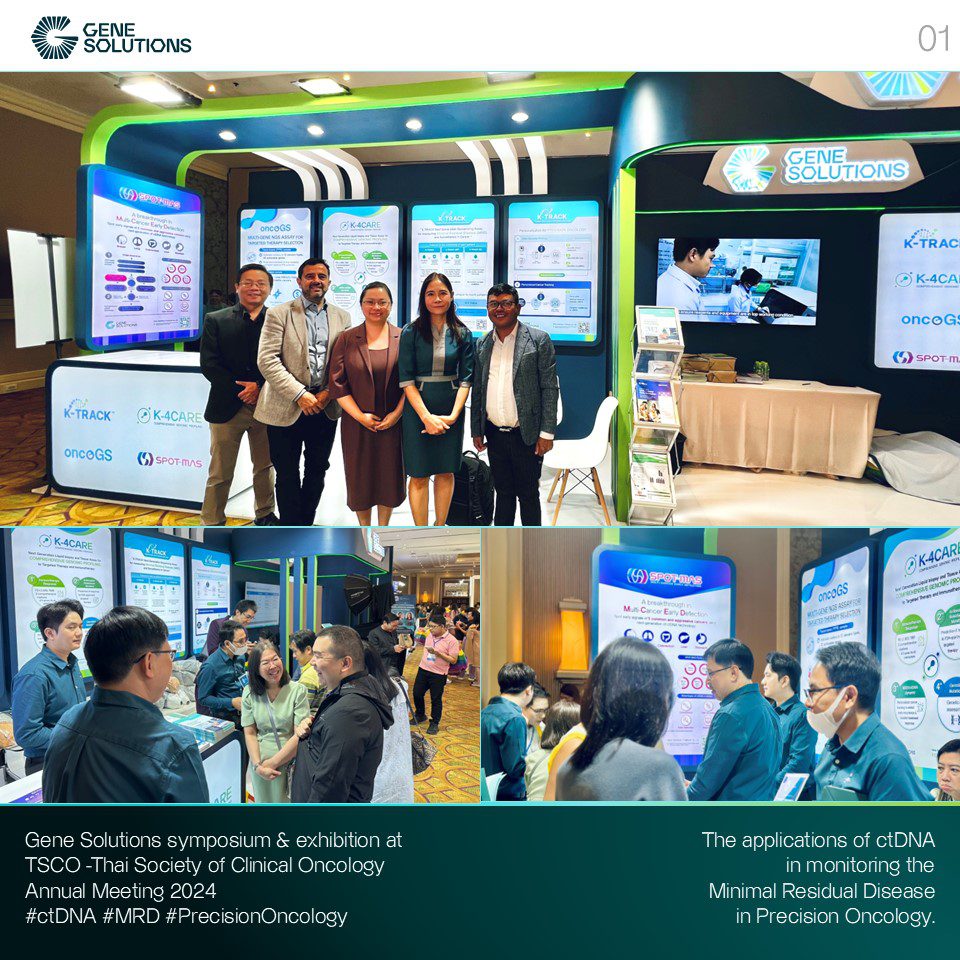
During Symposium 3, Gene Solutions presented an insightful session featuring Professor Nick Pavlakis from the University of Sydney and Dr. Tu Ngoc Ly Lan from the Medical Genetics Institute HCMC. They shared groundbreaking applications of Minimal Residual Disease (MRD) and discussed global clinical trials, showcasing the rapid advancements in circulating tumor DNA (ctDNA)-based testing.
Professor Pavlakis comprehensively reviewed all current aspects of ctDNA MRD, from technical approaches to clinical applications. In terms of technical strategies, he discussed two notable subjects: proven enrichment strategies using Hybridization Capture (NGS) or Multiplex PCR Amplification (NGS) to increase ctDNA sensitivity, and technical classifications to identify Clonal Hematopoiesis of Indeterminate Potential (CHIP), which has a mutational frequency of approximately 92% in 60-year-olds and can cause false positives.
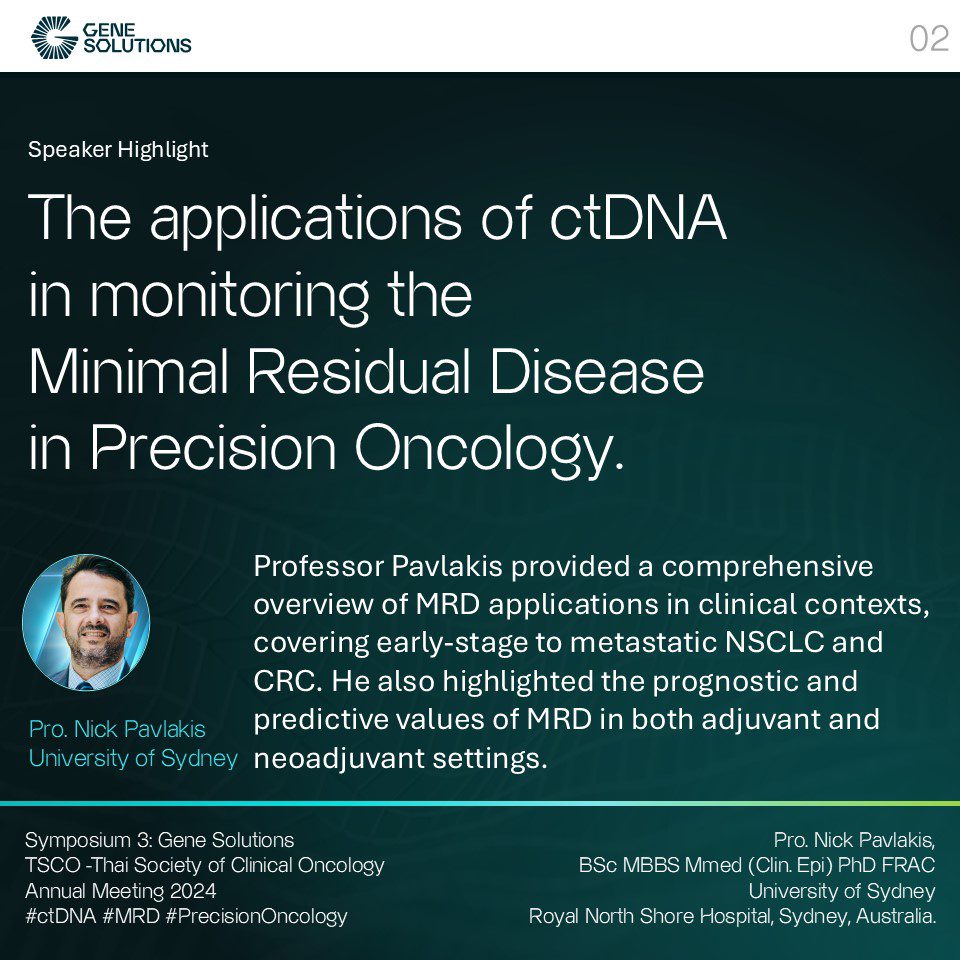
In clinical applications, Professor Pavlakis highlighted multiple studies that provided compelling evidence of MRD:
- Applications of ctDNA assay for MRD in early-stage curatively treated cancers: These applications vary from peri-operative prognostic and predictive uses, including escalation of adjuvant therapy (MRD+) in lung cancer, de-escalation/avoidance of adjuvant therapy (MRD-) in colorectal cancer, and surveillance/monitoring for recurrence.
- One study in resected EGFRm stage IB-IIIA NSCLC: This study showed that patients receiving adjuvant osimertinib were more likely to be DFS and MRD event-free compared to those receiving a placebo.
- One study in neoadjuvant chemotherapy in TNBC: ctDNA dynamics during neoadjuvant chemotherapy showed evidence in predicting clinical outcomes.
- One recent study in CRC demonstrated that a ctDNA-informed approach to adjuvant therapy selection in stage II colon cancer can reduce chemotherapy use without compromising survival rates.
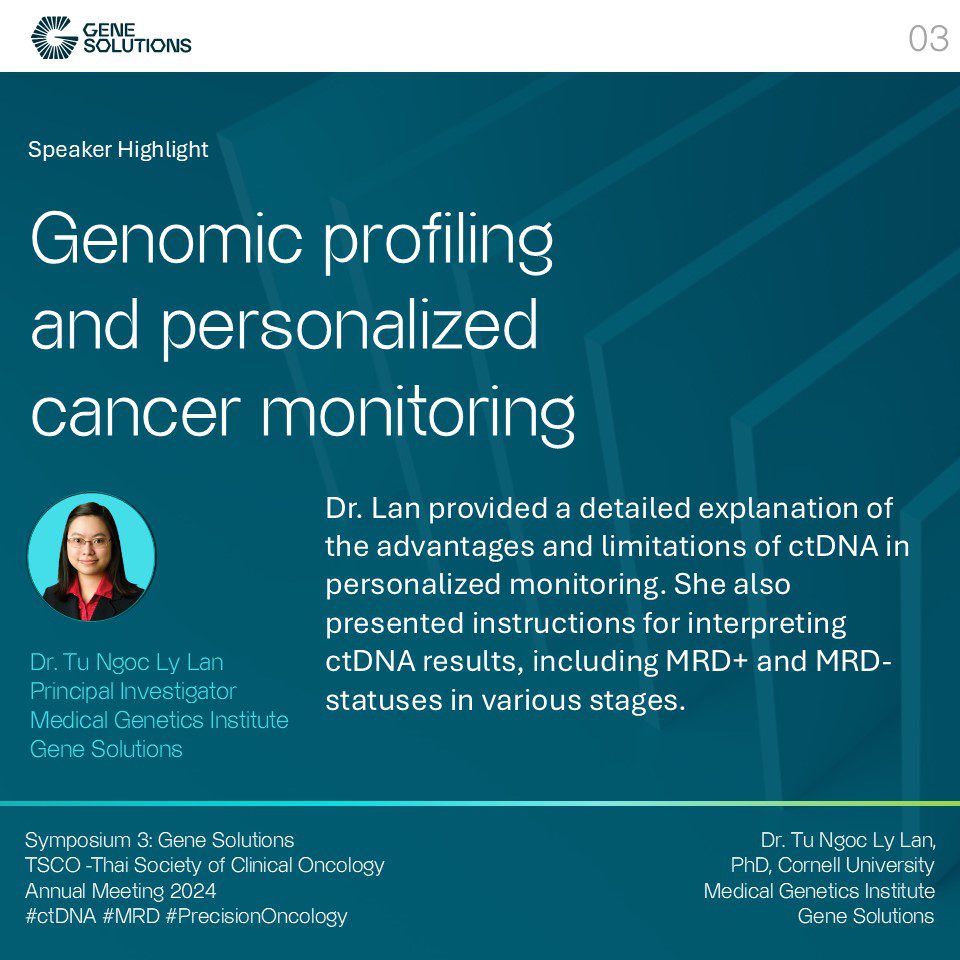
Dr. Tu Ngoc Ly Lan provided another perspective on current MRD methods, discussing the advantages and limitations of ctDNA and how to interpret its results. While it is widely acknowledged that ctDNA is more sensitive than conventional biomarkers and imaging in multiple cancers, she emphasized that no test detects ctDNA in 100% of cases. Detection rates can vary based on assay sensitivity, sample quality, and tumor location, particularly in cases with low ctDNA shedding, such as breast luminal cancer, lung adenocarcinoma, or metastatic sites in the brain, bone, and peritoneum.
The insights shared by the two experts enriched the audience’s overview of MRD, highlighting high-sensitivity methods and their application in clinical practice.
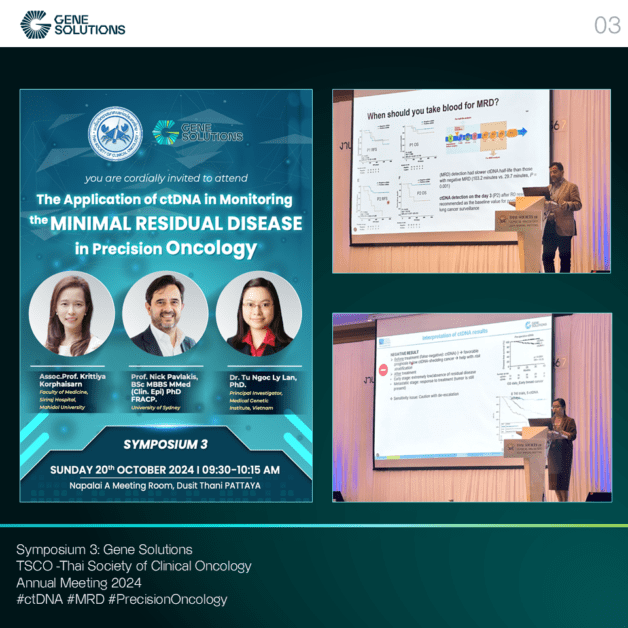
We deeply appreciate the organizers, moderators, speakers, and medical oncologists who participated in this cutting-edge sharing for the sake of better personalized cancer care.
#ctDNA #MRD # PrecisionOncology #Personalizedmonitoring #TSCO


