
K-TRACK at ASCO Breakthrough 2026: Two Landmark ctDNA Studies Earn Top 40 Abstracts Honors for Advancing Precision Oncology in Real-world Setting
The ASCO Breakthrough meeting in Singapore convened global oncology leaders to highlight innovations shaping the future of cancer care. In addition to the remarkable real-world data on SPOT-MAS 10 multi-cancer early detection, two groundbreaking K-TRACK ctDNA-MRD studies from Gene Solutions were also recognized among the 40 highest-rated abstracts.
These presentations captivated international oncologists and researchers while addressing critical clinical hurdles in precision oncology—from overcoming suboptimal tissue quality in developing regions to establishing superior longitudinal surveillance across diverse solid tumors.
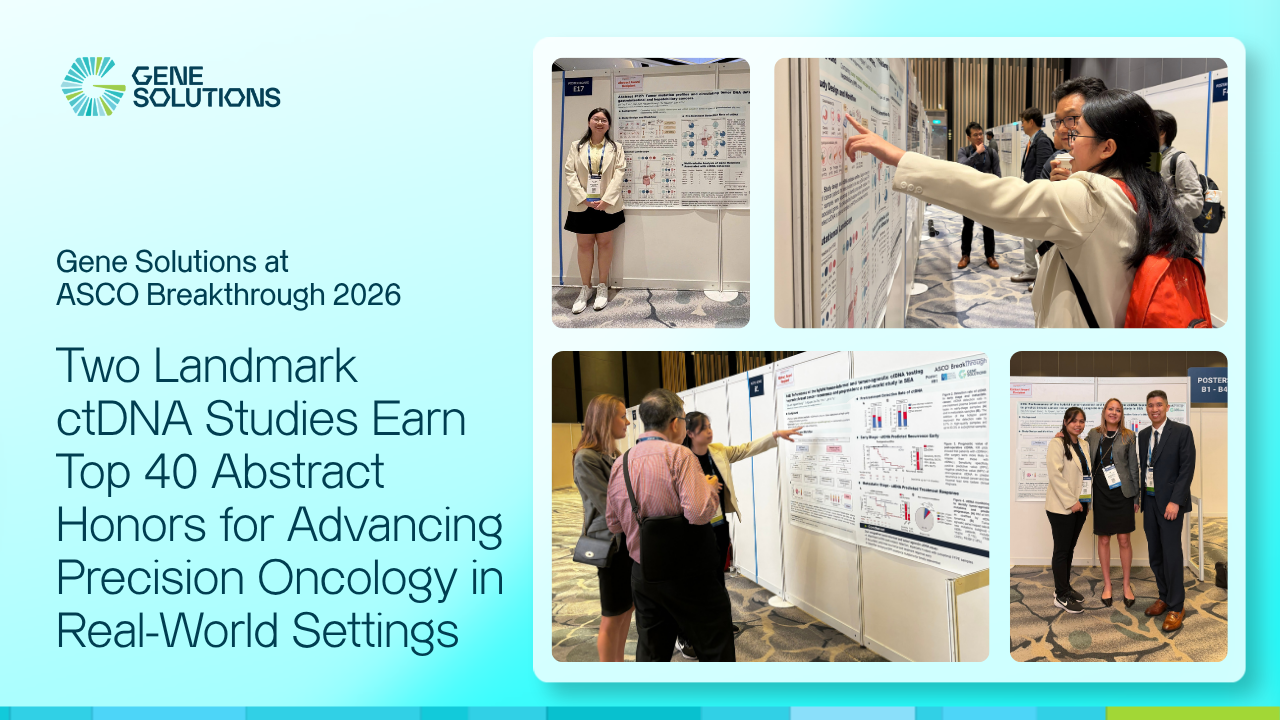
Below is a detailed recap of the methodology, clinical performance, and translational impact of these two studies.
Abstract 42: “Combining the Best of Both Worlds” in Breast Cancer ctDNA Testing
Presented by Van-Anh Nguyen Hoang and colleagues, this study tackled a problem familiar to anyone running ctDNA programs in resource-constrained settings: tumor-informed testing is powerful, but it depends on tissue specimens of a quality that isn’t always available in routine clinical practice. The Gene Solutions’ response was a hybrid design, the K-TRACK assay, which layers a tumor-agnostic hotspot panel of breast-cancer-specific mutations on top of the personalized, tumor-informed mutation set derived from paired tumor–white blood cell sequencing across 155 cancer-associated genes. The real-world cohort included 180 patients spanning early-stage (I–III) and metastatic (IV) disease.
During the poster presentation session, leading international oncologists described this hybrid design as “combining the best of both worlds”. Rather than choosing between the two current ctDNA methods, K-TRACK integrates their strengths. It maintains the accuracy of personalized tumor-informed tracking while relying on a comprehensive tumor-agnostic panel to rescue samples with compromised tissue quality and proactively detect resistance mutations in real time.
Key findings:
- Overcoming Suboptimal Tissue Barriers: In pre-treatment plasma samples, adding the tumor-agnostic hotspot panel improved ctDNA detection rates by 6.7% in high-quality FFPE samples. Remarkably, the hybrid approach boosted detection rates by up to 30.3% in suboptimal, low-quality tissue samples.
- Strong prognostic performance post-surgery: Among early-stage patients, postoperative ctDNA status sharply separated outcomes: 98.3% disease-free survival in ctDNA-negative patients versus 38.1% in ctDNA-positive patients (HR = 147.8, p < 0.0001), with sensitivity of 80.0%, specificity of 98.3%, and a lead time over clinical recurrence of up to 11 months.
- Treatment monitoring in the metastatic setting: Serial ctDNA tracking distinguished molecular responders from non-responders (HR = 6.0), with 70.0% sensitivity and 85.7% specificity for progression.
- Emerging resistance captured in real time: The tumor-agnostic panel identified ESR1 resistance mutations in metastatic estrogen receptor-positive (mER+) patients—with common variants including Y537N (7.1%), Y538G (3.6%), and P535H (1.8%)—offering a critical window for timely treatment adjustment before resistance becomes clinically apparent.
Abstract 127: Mutation Profiles and ctDNA Detection Across Gastrointestinal (GI) and Hepatobiliary (HPB) Cancers
Presented by Le-Tho T Vo and colleagues, this study broadened the lens considerably, comparing tumor mutation landscapes and ctDNA shedding patterns across nine cancer types — esophageal, gastric, colorectal (CRC), and GIST within the GI group; hepatocellular carcinoma (HCC), cholangiocarcinoma (CCA), gallbladder, pancreatic, and ampulla of Vater (AoV) cancers within the HPB group. To power this analysis, the team evaluated a large dataset encompassing: 1,519 FFPE samples for tumor profiling, 1,323 plasma samples for ctDNA detection, and 784 plasma samples across 207 patients for longitudinal surveillance in CRC, HCC, and gastric cancer.
Key findings:
- A clear mutational divide: TP53 and APC mutations dominated the GI cancers, while KRAS and TERT promoter mutations were more characteristic of HPB cancers — a distinction with direct implications for assay design and biomarker selection by tumor type.
- Detection rates tracked biology, not just stage: Pre-treatment ctDNA detection was highest in HCC (95%) and CRC (86% early-stage, 96% metastatic). At the metastatic stage, detection was higher in esophageal and CRC but comparatively lower in gastric cancer and GIST — a reminder that ctDNA shedding is tumor-biology-dependent and cannot be assumed uniform across cancer types.
- Mutation status predicted shedding: On multivariable analysis, tumors carrying KRAS (OR = 286.1), TP53 (OR = 165.3), or APC (OR = 89.7) mutations were significantly more likely to shed detectable ctDNA (all p < 0.001) — useful context for interpreting a negative result in tumors lacking these drivers.
- ctDNA outperformed standard-of-care (SOC) biomarkers in surveillance: Longitudinal ctDNA monitoring was an independent predictor of recurrence across all three cancers studied — CRC (HR = 91.0 vs. CEA’s HR = 3.2), HCC (HR = 17.9 vs. WAKO’s HR = 8.6), and gastric cancer (HR = 3.9 vs. CEA’s HR = 0.7) — with lead times over clinical relapse of up to 11.5, 7.3, and 8.8 months, respectively.
The Bigger Picture
Taken together, the two posters reflect a consistent mission at Gene Solutions: build ctDNA assays around the realities of real-world sample quality and diverse tumor biology, rather than around idealized trial conditions. The breast cancer study shows how a hybrid design can rescue sensitivity in suboptimal samples without sacrificing specificity. The GI/HPB study shows that the underlying mutational architecture of a tumor — not just its stage — should inform how ctDNA data is generated and interpreted.
For an international oncology audience increasingly reliant on ctDNA to guide adjuvant therapy decisions and surveillance schedules, both studies offer something concrete: large, real-world cohorts, clinically meaningful lead times ahead of radiographic or biochemical relapse, and a mutation-informed rationale for why detection rates vary the way they do.
About K-TRACK:
K-TRACK is a unique integration of comprehensive genomic profiling (CGP) of tumor tissue and high-sensitivity liquid biopsy for ctDNA molecular residual disease (MRD) monitoring. Designed to support routine precision oncology practice, it provides both treatment selection and longitudinal monitoring within a single assay, all delivered with a rapid turnaround time (TAT).
- Treatment Selection & Prognostic Insights: Guides decisions for targeted therapies and immunotherapies by reporting actionable and resistance mutations, microsatellite instability (MSI), pharmacogenomic markers (DPYD), and biomarkers of unknown significance.
- Treatment Monitoring & Real-Time Profiling: Dynamically detects ctDNA-MRD signals and identifies emerging actionable or resistance mutations via liquid biopsy in real time.
Explore our K-TRACK portfolio: K-TRACK Genomic Profiling & Molecular Residual Disease test | Gene Solutions Singapore


