
Top Abstract Poster Winner at 12th Asia-Pacific Breast Cancer Summit 2024
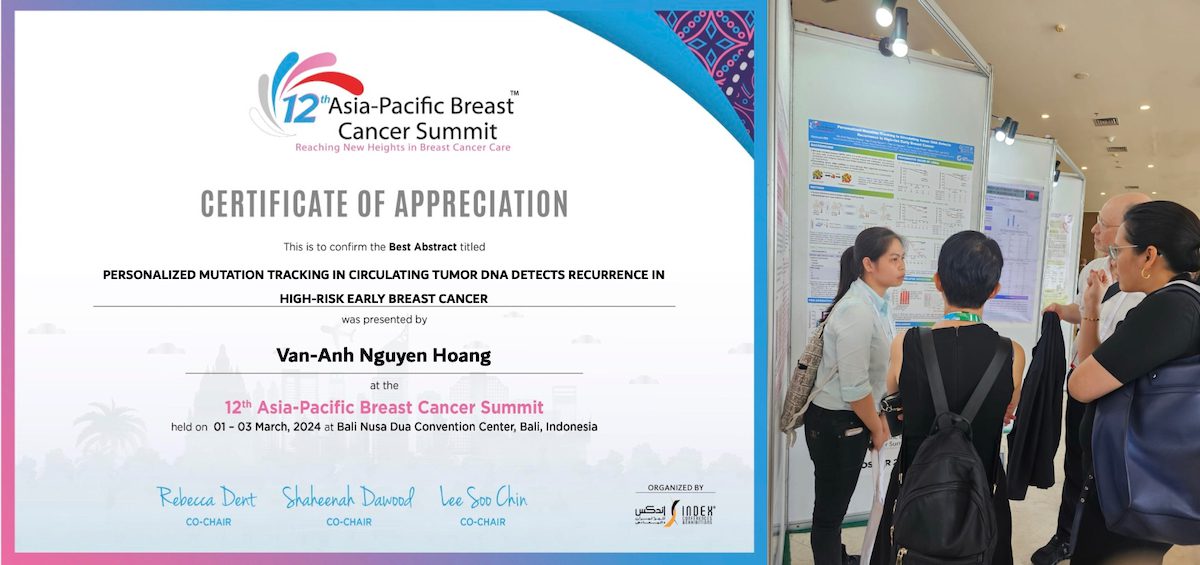
APBCS 2024 Appreciation Certificate (Best Abstract) – Van-Anh Nguyen Hoang
TOP ABSTRACT POSTER WINNER at 12th Asia-Pacific Breast Cancer Summit 2024, in Bali, Indonesia – “Personalized Mutation Tracking in Circulating Tumor DNA Detects Recurrence in High-risk Early Breast Cancer”
Congratulations to Gene Solutions R&D division! We are pleased to share that our scientist – Van-Anh Nguyen Hoang. received the Top Abstract Poster Award at the recent participation at 12th Asia-Pacific Breast Cancer Summit, held on March 1-3 2024. This award recognised our Oncology – Minimal Residual Disease (MRD) research unit’s efforts in coordinating a multi-centre Breast Cancer study following 165 patients with early-stage breast cancers, evaluating the clinical utility of a tumor-informed, personalized ctDNA assay to identify breast cancer patients at high risk of recurrence.
The outcomes of this longitudinal ctDNA monitoring showed clinical utility in predicting disease-free survival and early relapse detection in breast cancer patients. The simplified and cost-effective approach in K-TRACK enables MRD monitoring to be more accessible in routine clinical practice in resource-limited populations.
We interviewed our scientists – Van-Anh Nguyen Hoang and Dr. Lan Tu to share condensed highlights on this study.
1. What is this study about?
Ms. Hoang: This prospective multi-center study enrolled 165 breast cancer patients who were eligible for curative-intent surgery. This study aims to explore the role of ctDNA, analyzed by the K-TRACK™ assay, as a new marker for identifying breast cancer patients at high risk of recurrence and enabling earlier intervention.
2. Tell us about the study design and findings.
Ms. Hoang: Paired tumor FFPE and WBC DNA samples were sequenced to identify tumor-specific mutations in 95 cancer-associated genes. The top 1-9 mutations were used to detect ctDNA in serial plasma samples by bespoke multiplex PCR and ultra-deep sequencing.
Findings from the study –
- Early detection: ctDNA detection preceded clinical diagnosis of recurrence by a median of 9.7 months (3.3 – 13.2 months), potentially allowing for earlier intervention.
- Strong correlation with recurrence: 90% of patients with recurrence had detectable ctDNA after surgery, while 100% of patients with no recurrence had undetectable ctDNA. This suggests ctDNA as a potential tool to identify patients at high risk of recurrence.
- Prognostic value: Patients with ctDNA+ at any time after surgery had a significantly higher risk of relapse (HR=137.9, p<0.0001) compared to those with ctDNA-. The risk of relapse within 24 months for patients with high-risk ctDNA+ was 79.8%, compared to only 1.2% for patients with high-risk ctDNA- status.
3. Why does it matter? (Why is it significant)
Dr. Lan Tu: This study provides evidence that personalized ctDNA monitoring could be a significant advancement in breast cancer management. Early detection and better risk assessment can lead to improved treatment strategies and potentially better outcomes for breast cancer patients. ctDNA detection before surgery, post-surgery, and during treatment surveillance could help physicians stratify patients who may benefit from early therapeutic intervention or escalation.
Ms. Hoang: We found that the K-TRACKTM assay – Personalized ctDNA assay could be a valuable tool for improving breast cancer monitoring, especially in developing countries due to its simplified and potentially cost-effective approach.
4. Could you reference earlier work, and share with us future research direction by your team on MRD monitoring?
Dr. Lan Tu: The interim results of the study were presented at ASCO Breakthroughs 2023 in Japan and ESMO Asia 2023 in Singapore last year, where the teams achieved merit awards at both conferences. This study represented the complete and in-depth analysis of the use of ctDNA at different stages of breast cancer management. We are now collecting data of real-world performance of our ctDNA assay to monitor therapeutic response and detect recurrence in pan-cancer. Specifically for breast cancer, we also launched new clinical trials to investigate how ctDNA monitoring could predict clinical or pathological outcome in early-stage breast cancer patients undergoing neoadjuvant therapy, or metastatic patients undergoing immunotherapy.
Heartiest congratulations to our remarkable and dedicated scientists in investigating the performance of the K-TRACKTM assay. Reach out to them if you would like to collaborate and be part of our study.
If you would like to implement K-TRACK for your patients, please reach out to our team at Gene Solutions.


