
Two Best Poster Awards at ESMO Asia 2025
This year at ESMO Asia 2025 in Singapore, the R&D team from Gene Solutions was honored with two Best Poster Awards — recognition that reflects not only scientific excellence, but also a commitment to solving real clinical problems across the cancer care continuum.
EARLY DETECTION — WHEN ONE BLOOD SAMPLE NEEDS TO CAPTURE MORE
Best Poster 229P – Trang T. Tran
Integrated plasma cell-free RNA and DNA for improved early colorectal cancer detection
Background
Early detection of colorectal cancer (CRC) remains challenging. While colonoscopy is the gold standard, its invasiveness and limited compliance reduce population-level effectiveness. Blood-based ctDNA testing offers a minimally invasive alternative, but its sensitivity is inherently limited in early-stage disease due to the scarcity of tumor-derived DNA signals. To address this challenge, this study explores the integration of plasma cfRNA with ctDNA from a single blood sample to enhance early CRC detection.
How can we improve early CRC detection when tumor-derived signals are inherently scarce?
Rather than relying solely on ctDNA—which is often present at very low levels in early-stage CRC—the approach leverages cfRNA, which captures transcriptional and systemic signals associated with tumor presence and host response. By integrating cfRNA and ctDNA through a multi-omics framework, complementary biological information can be combined to improve detection performance when tumor-derived DNA alone is insufficient.
What the data showed
+ Plasma cfRNA and ctDNA profiling from a single 10 mL blood sample revealed distinct molecular signatures differentiating early-stage colorectal cancer from healthy controls.
+ cfRNA analysis identified CRC-associated transcriptional patterns, indicating that tumor-derived signals can be detected even when ctDNA levels are low.
+ cfRNA-only models demonstrated moderate sensitivity for early CRC detection.
+ Integration of cfRNA with ctDNA significantly improved overall detection performance compared with ctDNA alone.
+ The multi-omics approach achieved higher sensitivity while maintaining strong specificity.
+ The most pronounced performance gains were observed in early-stage CRC and precancerous lesions, highlighting the value of multi-omics integration when tumor-derived signals are inherently scarce.
Why this matters
These findings demonstrate that multi-omics integration of cfRNA and ctDNA can meaningfully enhance early CRC detection in a non-invasive manner. By capturing both genomic alterations and transcriptional signals, this approach addresses a key limitation of ctDNA-based screening in early disease. The strategy holds promise for complementing existing screening programs, particularly for improving detection at stages where intervention has the greatest clinical impact.
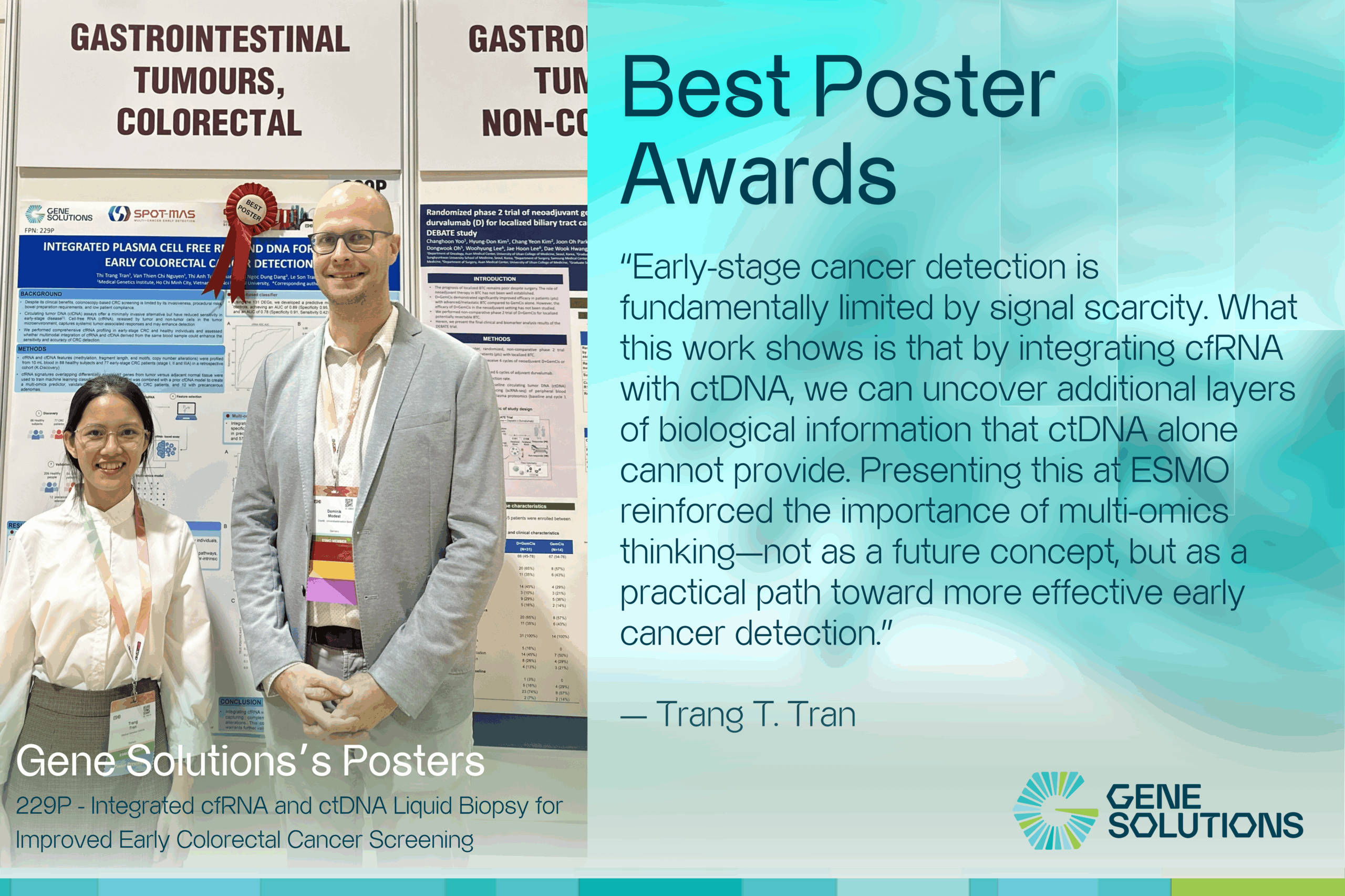
Trang T. Tran received Best Poster Award at ESMO Asia 2025
TREATMENT OPTIMIZATION — WHEN IMMUNE POWER MUST BE PREDICTABLE
Best Poster 183P – Thu Dao
Scalable platform to produce allogenic non-genetically modified NK cells and predict cytotoxicity in solid tumors
Background
Allogenic natural killer (NK) cell therapy has emerged as a promising immunotherapeutic strategy for cancer due to its scalability and favorable safety profile. While multiple strategies exist for allogenic NK cell expansion, there is a lack of comprehensive evaluations comparing these methods in terms of yield and functional efficacy. Addressing these gaps is critical for optimizing NK cell yield, functional efficacy, and clinical applicability.
What the study demonstrated
NK cells were then harvested by 2 methods: direct isolation from cord blood or differentiation from isolated CD34⁺ hematopoietic stem cells, followed by expansion using either K562-CD80-41BBL feeder cells or feeder-free cocktail containing K562-CD80-41BBL plasma membrane particles (PMPs) over 21 days.
Why this matters
- Expansion Efficiency: Direct isolation of NK cells from cord blood offers a scalable platform for generating NK cells with both high yield and strong functional efficacy, followed by expansion using feeder cells achieved >30,000-fold expansion in 21 days, while feeder-free cocktails yielded >10,000-fold expansion.
- Functional Stability: Both methods maintained strong cytotoxicity and phenotypic stability, whether cryopreserved or not.
- Predictive Algorithm: Cytotoxicity against MDA-MB-231 cells was not dependent on individual expression of NKG2D or PD1 alone (R² = 0.04 and 0.05 respectively). Instead, our algorithm developed to combine the matching between all NK receptors and tumor ligands, was able to predict cytotoxicity of different NK lines (R² = 0.69).
These results establish a scalable platform for NK cell production and introduce a novel computational tool for potency prediction.
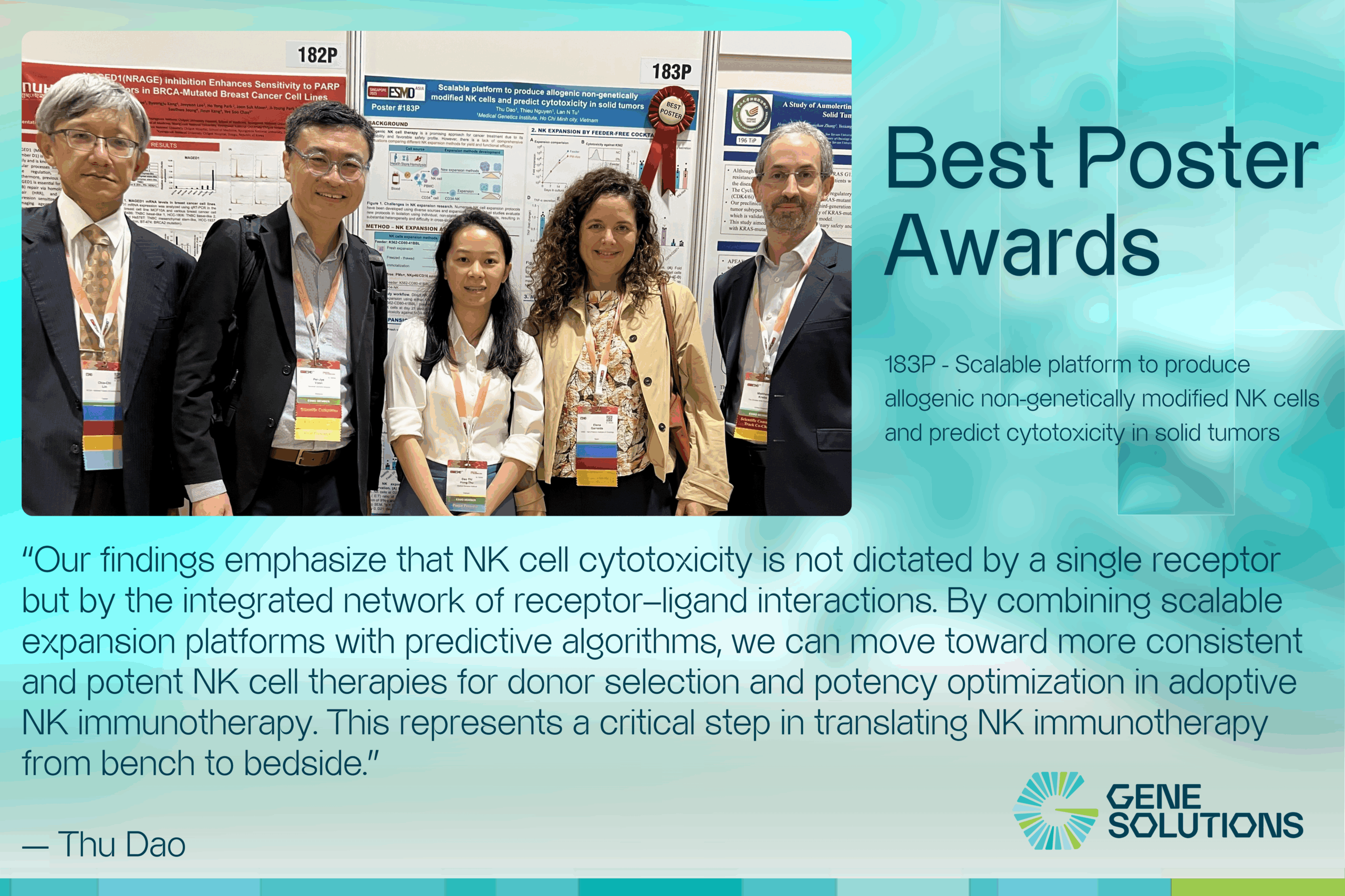
Thu Dao received Best Poster Award at ESMO Asia 2025
One Journey, Two Perspectives
One poster focuses on detecting cancer earlier, when intervention can change outcomes.
The other focuses on treating cancer smarter, where predictability and control are essential.
Together, these two Best Poster Awards reflect a shared vision: from early detection to optimized treatment — guided by biology, data, and clinical relevance.
Congratulations to Trang T. Tran, Thu Dao, and the entire R&D team at Gene Solutions for advancing cancer research with patients at the center.


