
ESMO Congress 2026: Gene Solutions to Present AI-Enabled Multi-omic Liquid Biopsy
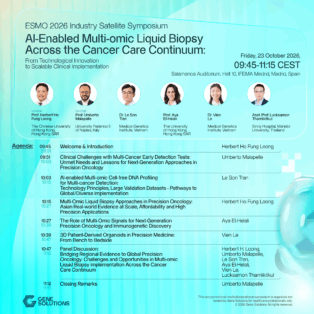
Gene Solutions will host an Industry Satellite Symposium at ESMO Congress 2026, bringing together international experts to examine how AI-enabled multi-omics and cell-free DNA analysis can move from technological innovation to evidence-based decisions that health systems can implement at scale across the cancer care continuum.
ESMO Congress 2026 will take place 23–27 October in Madrid. The session is scheduled for Friday, 23 October, 09:45–11:15 CEST, in the Salamanca Auditorium, Hall 10, IFEMA Madrid.
AI and multi-omics are opening new possibilities across cancer detection, treatment selection, and disease monitoring. The question now is how the growing evidence can support accessible testing and decisions that health systems can implement at scale.
AI-Enabled Multi-omic Liquid Biopsy Across the Cancer Care Continuum: From Technological Innovation to Scalable Clinical Implementation
The programme addresses a practical gap in precision oncology: how multi-omic liquid biopsy can be applied across the cancer care continuum—from earlier detection through high-precision treatment applications—with the evidence, affordability, and implementation pathways that clinical practice requires.
Examining the next generation of multi-cancer early detection
Opening the scientific programme, Prof. Umberto Malapelle of the University of Naples Federico II will examine the clinical challenges associated with current multi-cancer early detection tests. The presentation, “Clinical Challenges with Multi-Cancer Early Detection Tests: Unmet Needs and Lessons for Next-Generation Approaches in Precision Oncology,” will address the clinical questions and evidence requirements that will shape the next generation of early cancer detection approaches.
Combining AI, multi-omics, and cell-free DNA analysis
Dr. Le Son Tran of the Medical Genetics Institute will present “AI-Enabled Multi-omic Cell-Free DNA Profiling for Multi-Cancer Detection: Technology Principles, Large Validation Datasets, and Pathways to Global Implementation.”
The presentation will explore the scientific principles behind AI-enabled multi-omic cell-free DNA analysis and discuss the importance of large validation datasets in developing clinically relevant multi-cancer detection approaches. It will also examine considerations for broader implementation.
Learning from Asian real-world evidence at scale
Prof. Herbert Ho Fung Loong of the Chinese University of Hong Kong will present “Multi-Omic Liquid Biopsy Approaches in Precision Oncology: Asian Real-World Evidence at Scale, Affordability, and High-Precision Applications.”
The session will discuss the value of dual tissue and liquid multi-omic profiling, with integrated hybrid tumour-informed and tumour-naïve ctDNA monitoring in early-stage and metastatic disease. Asian real-world evidence at scale will be presented, including considerations related to access and affordability.
Exploring multi-omic signals and immunogenetic discovery
Prof. Aya El-Helali of the University of Hong Kong will discuss “The Role of Multi-Omic Signals for Next-Generation Precision Oncology and Immunogenetic Discovery.”
The presentation will explore how the integration of complementary biological signals—including genomic, transcriptomic, neoantigen, and tumour-microenvironment data—may address the limits of single-biomarker testing and support immunogenetic discovery.
Connecting patient-derived models with precision medicine
Dr. Vien Le of the Medical Genetics Institute will present “3D Patient-Derived Organoids in Precision Medicine: From Bench to Bedside.”
The presentation will examine how patient-derived organoid models can add functional biological insights and support the translation of laboratory innovation into precision medicine applications, including an ongoing clinical validation study. Within the broader symposium, this work will connect molecular profiling with a complementary model for better understanding individual tumor biology and advancing personalized cancer care.
From regional evidence to global precision oncology
The programme will conclude with a panel discussion titled:
“Bridging Regional Evidence to Global Precision Oncology: Challenges and Opportunities in Multi-omic Liquid Biopsy Implementation Across the Cancer Care Continuum.”
Panelists will include:
- Prof. Herbert Ho Fung Loong, The Chinese University of Hong Kong, Hong Kong SAR
- Prof. Umberto Malapelle, University Federico II of Naples, Italy
- Dr. Le Son Tran, Medical Genetics Institute, Viet Nam
- Prof. Aya El-Helali, The University of Hong Kong
- Dr. Vien Le, Medical Genetics Institute, Viet Nam
- Asst. Prof. Lucksamon Thamlikitkul, Siriraj Hospital, Mahidol University, Thailand
The discussion will consider the practical and scientific requirements for translating regional evidence into broader clinical implementation, including evidence generation, affordability, healthcare infrastructure, clinical adoption, and the responsible deployment of new technologies. Asst. Prof. Thamlikitkul will also present a case study on hybrid ctDNA MRD monitoring in lung cancer from Thailand.
A precision cell-free DNA platform across the cancer continuum
Gene Solutions offers an integrated precision cell-free DNA platform for multi-omic screening, profiling and ctDNA monitoring across the cancer care continuum, with complementary functional models in development. The symposium reflects the company’s mission to make precision testing accessible to millions of people, so more patients can receive an answer in time to act.
Symposium details
Date: Friday, 23 October 2026
Time: 09:45–11:15 CEST
Venue: Salamanca Auditorium, Hall 10
Location: IFEMA Madrid, Spain
Official session page:
https://cslide.ctimeetingtech.com/esmo2026/attendee/confcal/show/session/106
This non-promotional medical educational symposium is organized and funded by Gene Solutions for healthcare professionals only.


