
ASCO 2026 RECAP | GENE SOLUTIONS PRESENT TWO CLINICAL STUDIES ADVANCING ctDNA APPLICATIONS IN CANCER CARE
At the 2026 American Society of Clinical Oncology (ASCO) Annual Meeting in Chicago, USA, Gene Solutions, in collaboration with the Medical Genetics Institute (MGI), proudly presented two landmark scientific abstracts. These studies represent a major milestone in advancing liquid biopsy (ctDNA) applications across Southeast Asia, spanning from early-stage multi-cancer triage for symptomatic individuals to postoperative molecular recurrence monitoring and real-time therapeutic response tracking in metastatic settings.
✨Abstract ID 10555
“K-ACCELERATE: A Multi-Center Prospective Trial Evaluating the Utility of a ctDNA-Based Assay for Accelerating Multi-Cancer Diagnosis Among High-Risk Symptomatic Participants”
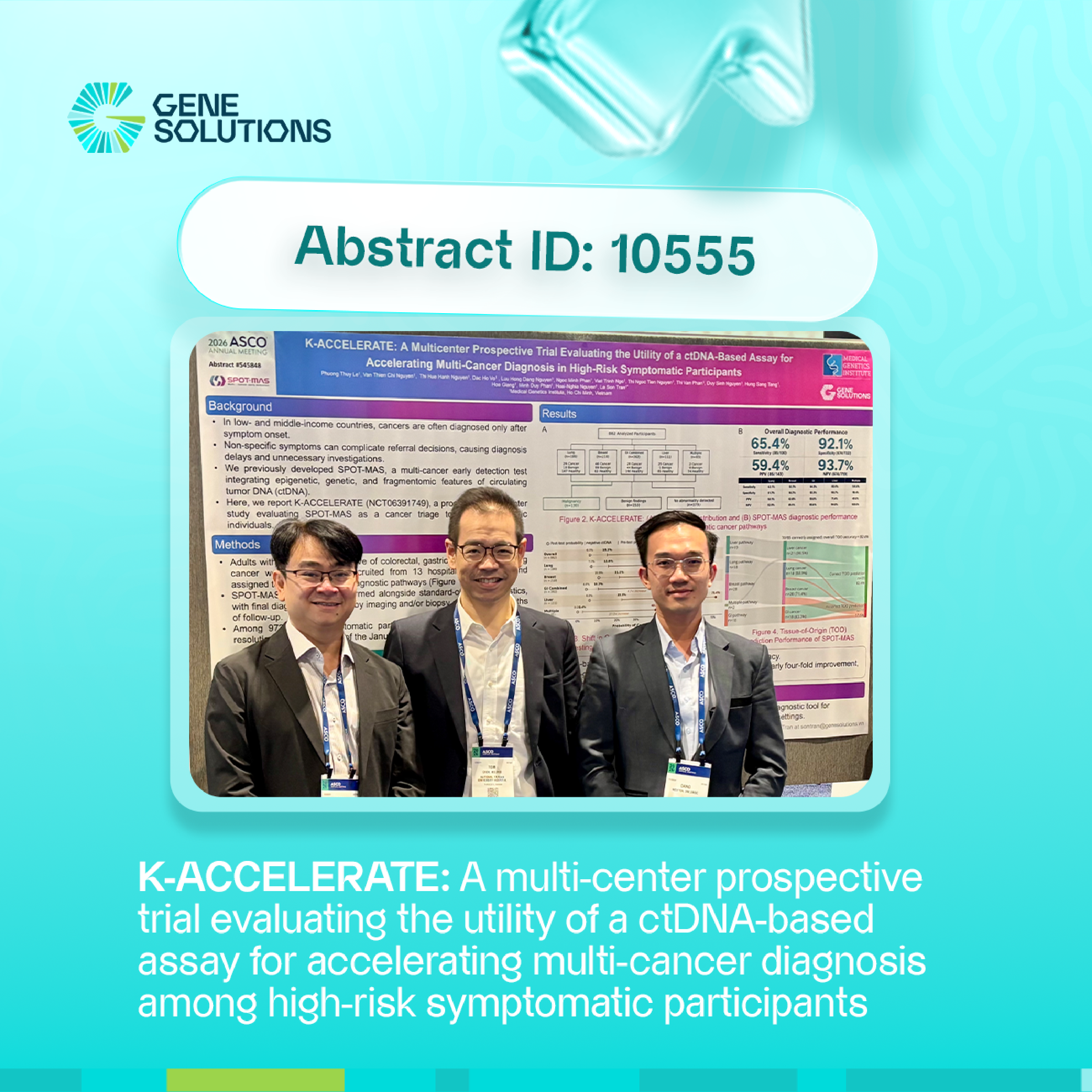
This clinical trial evaluated the performance of the SPOT-MAS assay as a triage and localization tool among 862 participants presenting with suspicious clinical symptoms.
📌 Key Results and Clinical Interpretations:
👉 1. OVERALL DIAGNOSTIC PERFORMANCE OF SPOT-MAS
- Result: Across 862 symptomatic participants, the SPOT-MAS assay demonstrated an overall sensitivity of 65.4% (85/130 malignancies detected) and a specificity of 92.1% (674/732 benign or healthy cases correctly identified), backed by a high negative predictive value (NPV) of 93.7%.
- Clinical Meaning: The exceptionally high specificity and NPV confirm a remarkably low false-positive rate. This offers robust clinical reassurance for patients receiving a negative result, alleviating psychological distress and sparing them from unnecessary, repetitive diagnostic workups.
👉 2. SHIFT IN CANCER RISK PROBABILITY AFTER ctDNA TESTING
- Result: Following ctDNA testing, the post-test cancer probability demonstrated sharp stratification, shifting from a baseline pre-test prevalence of 15.1% up to 59.4% for positive results (a nearly four-fold increase).
- Clinical Meaning: This powerful probability shift establishes the assay as an effective triage tool in real-world clinical workflows. It allows physicians to confidently fast-track high-risk individuals (positive ctDNA) into urgent, definitive diagnostic pathways while optimizing medical resources and reducing costs for low-risk individuals (negative ctDNA).
👉 3. TISSUE-OF-ORIGIN (TOO) PREDICTION PERFORMANCE OF SPOT-MAS
- Result: The ctDNA-based tissue-of-origin prediction successfully localized the primary tumor site with an overall accuracy of 82.4%, correctly assigning 70 out of 85 confirmed cancer cases across major diagnostic pathways.
- Clinical Meaning: Pinpointing the specific organ of origin (e.g., lung, liver, breast, or GI tract) provides precise, actionable guidance to clinicians. Instead of conducting blind, whole-body imaging, physicians can immediately direct targeted confirmatory imaging and biopsies, significantly minimizing diagnostic turnaround time to initiate definitive treatment sooner.
✨ Abstract ID 3058
“Leveraging a Hybrid Tumor-Informed and Tumor-Agnostic ctDNA Assay for Optimal ctDNA MRD Detection: A Real-World Study in Southeast Asia”
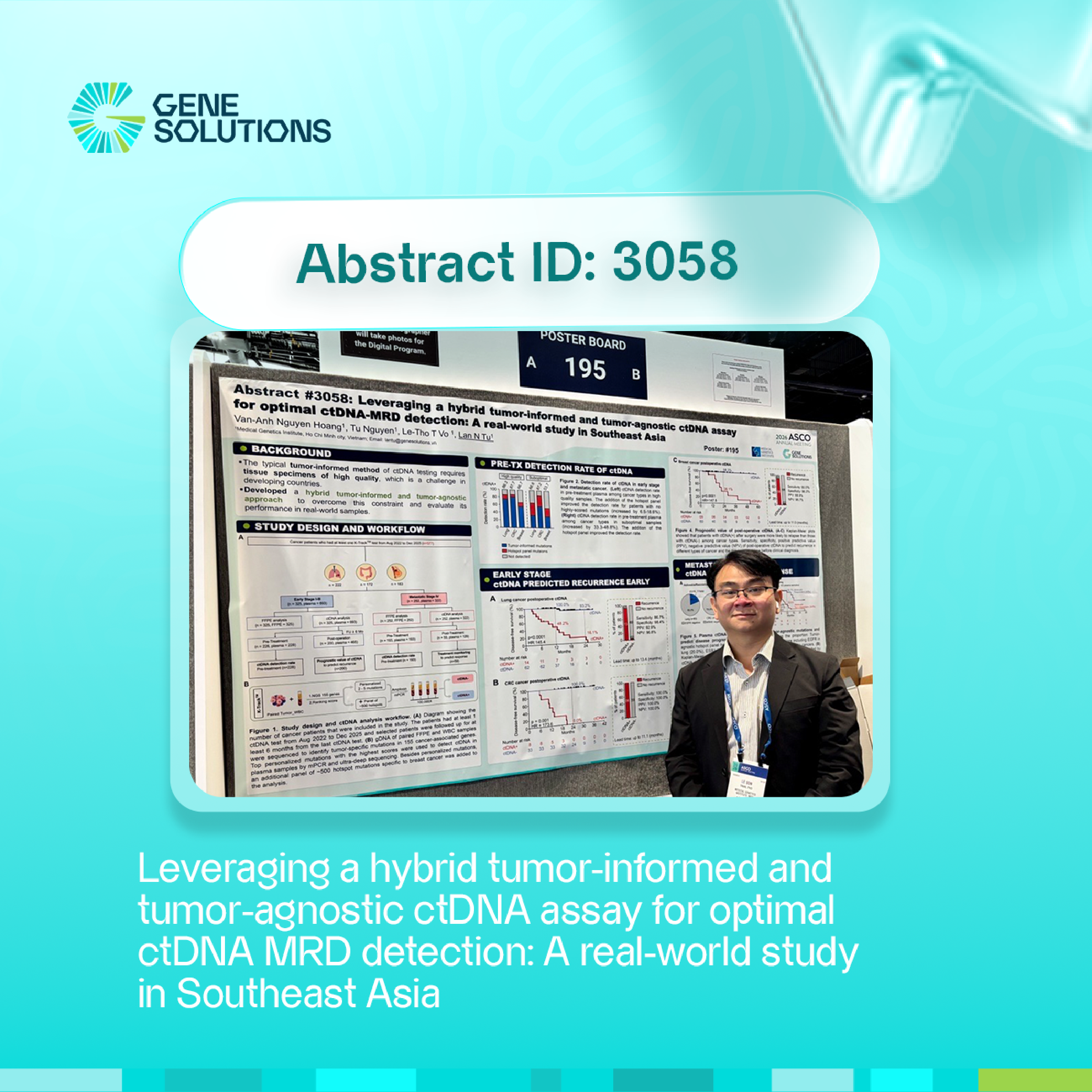
This study validated the clinical utility of a hybrid technology (K4CARE™) designed to overcome tissue availability limitations, focusing on risk stratification post-surgery (early stage) and treatment response monitoring (metastatic stage).
📌 Key Results and Clinical Interpretations:
👉 1. PRE-TX DETECTION RATE OF ctDNA
- Result: The integration of a tumor-agnostic hotspot panel improved the overall ctDNA detection rate by 6.5% – 18.6% in high-quality tissue samples (achieving a baseline rate of 66,7% – 87,7%) and significantly enhanced it by 33.3% – 48.8% in suboptimal tissue samples (recovering the detection rate to 53,7% – 87,2%) across lung, colorectal, and breast cancers.
- Clinical Meaning: This trend proves that a hybrid assay effectively overcomes the primary technical bottleneck of traditional liquid biopsies. It guarantees high analytical sensitivity and protects against false negatives, even when encountering low-quantity or degraded tissue specimens typical in routine clinical practice.
👉 2. EARLY STAGE ctDNA PREDICTED RECURRENCE
- Result: Postoperative ctDNA positivity was strongly associated with a drastic decline in disease-free survival (DFS), presenting exceptionally high hazard ratios across lung (HR = 145.4), colorectal (HR = 173.6), and breast cancers (HR = 147.8) with uniform statistical significance. Furthermore, the assay provided a maximal lead time of 11.0 to 13.4 months ahead of standard clinical imaging.
- Clinical Meaning: Postoperative ctDNA serves as a powerful prognostic biomarker. Detecting residual disease at the molecular level nearly a year before tumors become visible on traditional CT or MRI scans opens an invaluable “window of opportunity,” allowing oncologists to initiate early adjuvant therapies (chemotherapy, targeted therapy, or endocrine therapy) to eradicate micrometastases before overt relapse.
👉 3. METASTATIC STAGE ctDNA PREDICTED Tx RESPONSE
- Result: ctDNA profiling successfully identified emergent secondary resistance mutations (including 20.0% EGFR T790M in lung, 25.0% KRAS G12D in colorectal, and 12.5% ESR1 variants in breast cancers). Quantitatively, molecular non-responders (patients with a <50% ctDNA decrease from baseline post-treatment) exhibited a 9.68-fold higher risk of disease progression or death compared to molecular responders (HR = 9.68; p < 0,0001).
- Clinical Meaning: Longitudinal ctDNA dynamics supply real-time tracking of therapeutic efficacy, enabling clinicians to evaluate drug response within weeks rather than waiting months for radiological evaluation. Additionally, capturing emergent clonal resistance profiles early allows physicians to proactively adapt targeted regimens before clinical disease progression occurs.
✨ Abstract No. 532944 – Clinical collaboration: insights from the MELODY study
“ Maintenance Pegylated Liposomal Doxorubicin Versus Surveillance For Advanced Soft Tissue Sarcoma Patients Who Had Controlled Disease After Standard Anthracycline-based treatment (MELODY)”
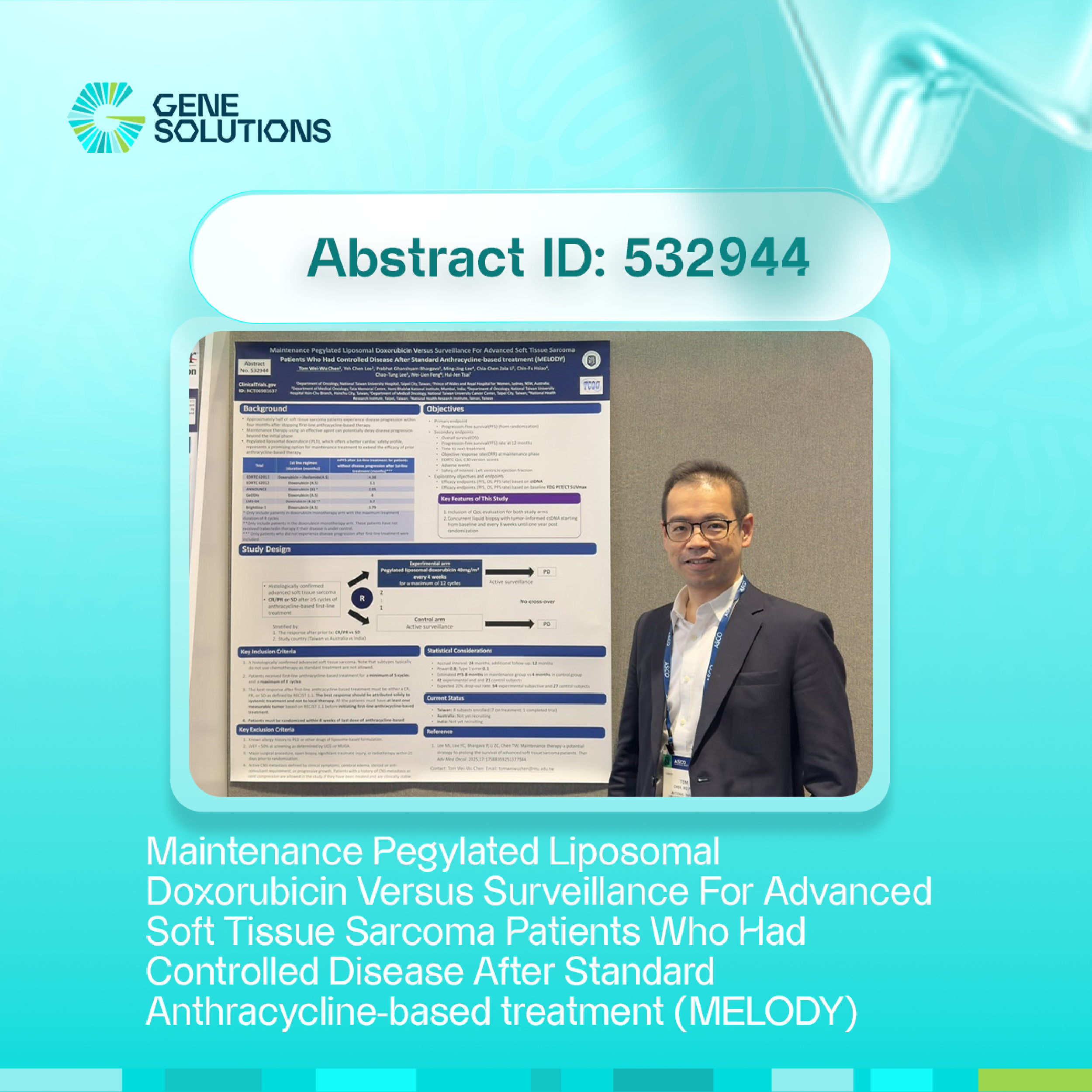
Beyond common epithelial malignancies, the clinical value of serial liquid biopsy was further spotlighted by Dr. Tom Wei-Wu Chen (National Taiwan University Hospital, Taiwan) in his presentation on the multinational Phase II MELODY study. The trial evaluates the efficacy of maintenance pegylated liposomal doxorubicin versus active surveillance in patients with advanced soft tissue sarcoma who achieved disease control after first-line anthracycline chemotherapy.
- The Integration: Because soft tissue sarcoma is both uncommon and highly heterogeneous, encompassing diverse histologies and complex genomic profiles, imaging often appears stable despite frequent early relapses. To turn these molecular uncertainties into actionable clinical knowledge, the MELODY trial incorporates an exploratory biomarker arm in collaboration with Gene Solutions, utilizing a personalized, tumor-informed ctDNA tracking approach.
- Clinical Significance: Dr. Chen highly commended the clinical utility of Gene Solutions’ platform, specifically emphasizing the value of detailed, mutation-level reporting. Rather than providing a simple binary positive or negative result, the assay specifies the exact variants being tracked—identifying precisely which mutations are counted to call a sample positive. This high-resolution molecular signaling delivers superior, real-time therapeutic guidance, paving the way for refined surveillance and early progression prediction in rare cancers.
CONCLUSION
The dual clinical data presented by Gene Solutions at ASCO 2026 deliver robust, real-world evidence for the clinical utility of ctDNA liquid biopsies. By streamlining multi-cancer triage for symptomatic patients, personalizing adjuvant strategies post-surgery, and tracking therapeutic resistance in advanced stages, ctDNA technology is cementing its role as an indispensable tool to improve survival rates and patient care quality across Southeast Asia.
✨ Learn more about Abstract here:
K-ACCELERATE: https://genesolutions.com/clinical-resources/posters?document=91583
MRD: https://genesolutions.com/clinical-resources/posters?document=91561


